Educator Employment Guide
Job Description & Duties
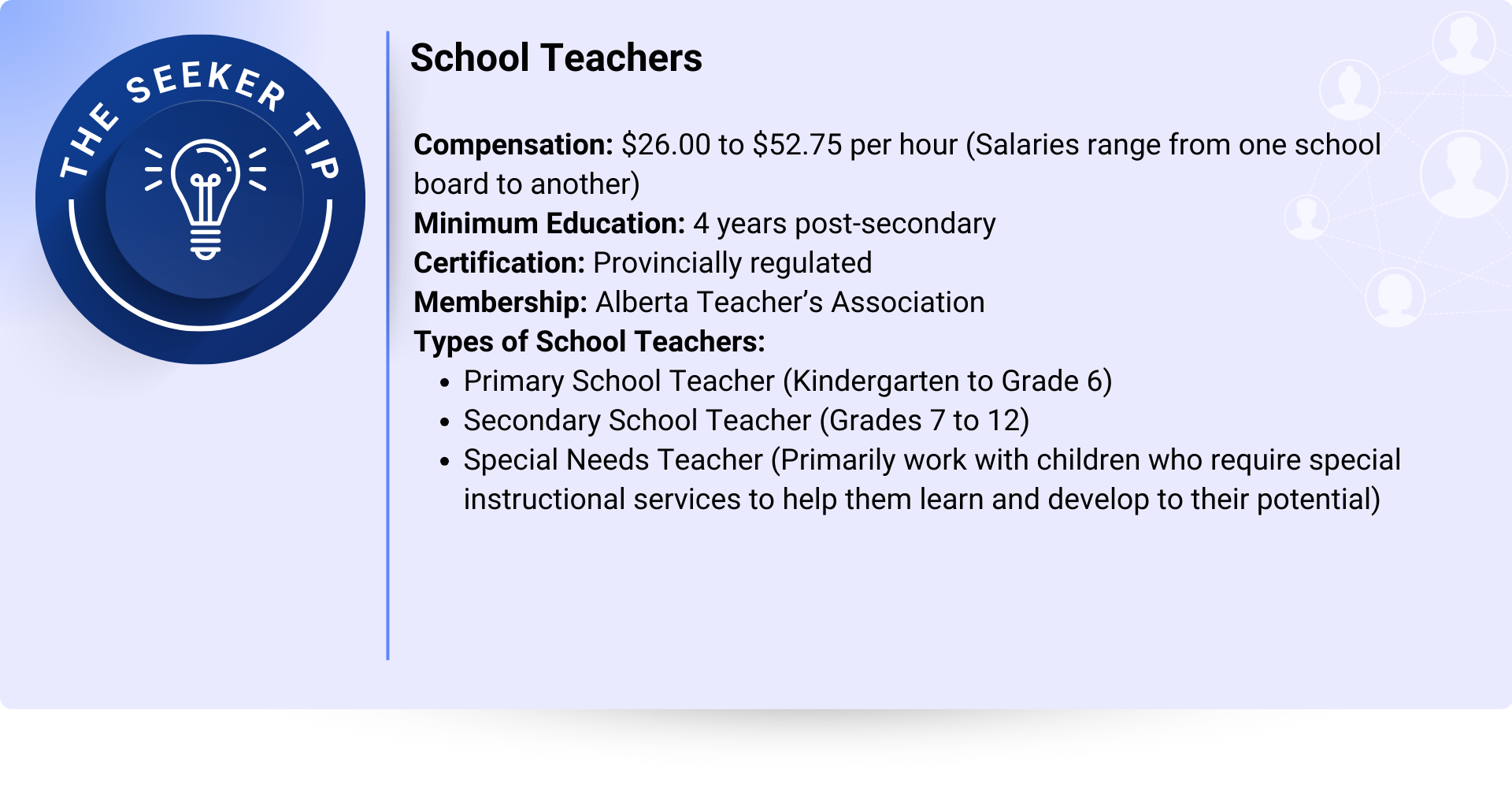
Teaching (Elementary & Secondary) - NOC 41221 and 41220
The 2021 National Occupational Classification (NOC) code adopted on November 16th, 2022 by IRCC for Elementary school and kindergarten teachers is 41221. The NOC code for Secondary School Teachers is 41220. In Alberta, teachers in the K to 12 system work at the elementary (Kindergarten to Grade 6), junior high (Grades 7 to 9), or high school (Grades 10 to 12) levels. Elementary and junior high teachers are typically generalists. However, it is preferred that high school teachers have subject area expertise.
Elementary school teachers teach and facilitate the learning of children aged 4 to 12 years (Kindergarten to Grade 6). They teach basic subjects such as reading, writing and arithmetic or specialized subjects such as English or French as a second language at elementary schools. Secondary school teachers prepare and teach academic, technical, vocational or specialized subjects at public and private secondary schools (Grades 7 to 12). Secondary school teachers who are heads of departments are included in the NOC 41220.
Duties
Elementary and secondary school teachers’ general duties include:
Identify children’s individual and collective learning needs for their age and grade
Plan and deliver instruction based on student learning needs and approved curriculums
Provide a stimulating learning environment in which each child can experience growth and develop to their potential using the course material
Lead students in activities to promote their physical, mental and social development and school readiness
Evaluate students' progress and discuss results with students, parents and school officials
Prepare and implement remedial programs for students requiring extra help
Participate in staff meetings, educational conferences and teacher training workshops
May advise students on course selection and vocational and personal matter
May teach and evaluate students through distance or online courses
May supervise teachers' aides and student teachers
Skills
Genuine interest in children and respect for their individuality
Creativity, imagination, patience and high energy
Resourcefulness
Strong interpersonal and communication skills
Strong leadership and teamwork skills
A clear speaking voice and the ability to convey confidence
Positive conflict resolution skills and the ability to handle stress well
Strong organizational skills
The ability to establish rapport with children and parents
Education and Experience
Alberta Education is the Government of Alberta ministry that funds education. The minister of education is responsible for who holds teaching authority in Alberta. The Registrar at Alberta Education is responsible for evaluating credentials and issuing Alberta teacher certifications.
Generally speaking, the education required for early childhood, elementary, and secondary teachers is:
4 years of post-secondary education to obtain a degree, usually followed by a bachelor of education (B.Ed.) degree or equivalent. Explore education programs at the University of Calgary, Mount Royal University, Ambrose University, or the University of Alberta.
Provincial teaching certificate
Certification is required to teach English or French as an additional language
Qualifications
A valid Alberta teaching certificate is required to teach in Alberta. The first step is to apply for Interim Professional Certification (IPC) so that Alberta Education can assess the educational and professional qualifications. If the requirements are met, the IPC allows teaching anywhere within the province's K to 12 system and is valid for 3 years. When all the requirements for Permanent Professional Certification (PPC) are met, the school authority must recommend the teacher for a permanent certificate. A PPC does not expire, even if the teacher leaves the profession. For initial certification, all teachers in Alberta require a minimum of 16 years of formal education, which includes a 4-year university degree with a pre-service teacher preparation program from an approved institution.
Elementary Teacher Initial Certification
Elementary teachers must complete a minimum of 24 semester-hour credits in coursework that includes:
3-semester hour credits in Canadian Studies
3-semester hour credits in Mathematics
3-semester hour credits in Science
6-semester hour credits in English or French Literature and Composition
Secondary Teachers Initial Certification
Secondary teachers must complete the following:
24-semester hour credits in a teachable subject area
6-semester hour credits in English or French Literature and Composition
Elementary and Secondary Teachers Permanent Certification
To obtain a permanent professional certificate, applicants must provide proof of the following:
2 years of full-time teaching experience (approximately 400 days equivalent) in an Alberta-accredited school while holding a valid Interim Professional Certificate
2 successful evaluations of classroom performance based on meeting the requirements in the Teaching Quality Standard
Recommendation from the employing school authority
Internationally Educated Teachers
Certification
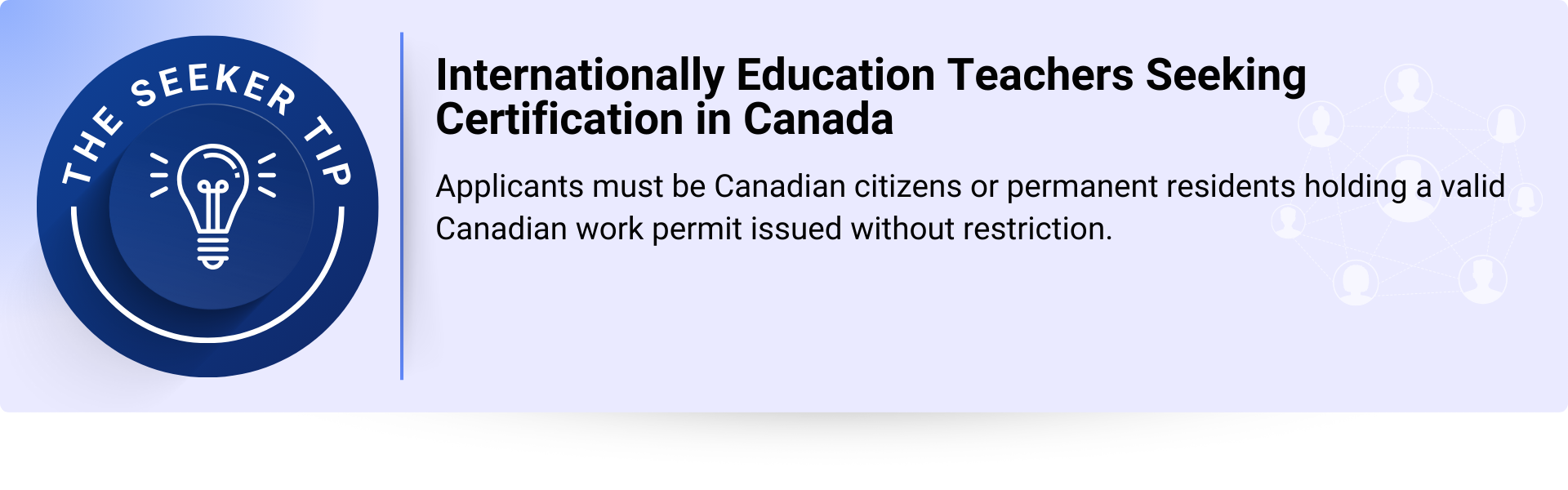
All applicants for certification, including internationally educated teachers, must meet the above criteria, and academic credentials will be assessed on a course-by-course basis. If international education is not acceptable to the Minister of Education, the applicant may need additional courses to qualify for an Interim Professional Certificate. When the assessment is complete, the applicant will receive a letter of assessment detailing the application’s outcome.
Credential Evaluation
Alberta Education and the universities in Alberta do not recognize credential assessments completed by other agencies, such as World Education Services (WES) or International Qualifications Assessment Services (IQAS). They complete their credential evaluations for teacher certification and admissions. Official transcripts must be sent directly to their offices by the applicant’s former university or other postsecondary institution.
Bridging Programs
The University of Alberta and the University of Calgary offer bridging programs for internationally educated teachers who do not yet qualify for Alberta teaching certification. Applicants must have completed applying for interim certification through Alberta Education and have an assessment letter.
Diploma Program for Internationally Educated Teachers at the University of Alberta:
Full-time, a 24-credit program with 15 credits of prescribed coursework in Education and a 9-week (45 days) supervised teaching placement/field experience in schools.
Internationally educated teachers requiring more than 24 credits for interim certification or coursework outside of Education are supported by an advisor to discuss possibilities for completing these requirements before the diploma.
Bridge to Teaching Program at the University of Calgary:
8 months with 18-semester hour credits in Education at the advanced level and a minimum of 10 weeks of supervised student teaching in a classroom.
The Bredin Centre also offers resources and support for internationally educated teachers.
Alberta’s School System
School Divisions
The Alberta Kindergarten to Grade 12 (K to 12) school system includes programs for preschool to senior high school students.
Kindergarten is the year before entry into Grade 1 of Elementary School. It takes place in Early Childhood Services (ECS). Students are usually 5 years old.
Grades 1 to 6 are part of the Elementary school division. Students are usually between 6 and 12 years old. Required courses are Language Arts, Mathematics, Science, Social Studies, Art and Music, Health and Physical Education. Optional courses vary depending on the school.
Grades 7 to 9 are part of the Junior High school division. Students will gradually make the transition from one teacher to multiple teachers. Students are usually between 12 to 15 years old. Required courses are Language Arts, Mathematics, Science, Social Studies, Physical Education, Health and Personal Life Skills. Information and communication technology learner outcomes are infused within core subjects and provincially approved options.
Grades 10 to 12 are part of the Senior High school division. Students are usually between 15 to 18 years old. Senior High schools offer many choices, from academic courses for university admission to knowledge and employability courses to develop occupational competencies. Programs vary by authority and school.
Types of Schools
Alberta’s education system consists of the following:
Public schools
Separate schools (Roman Catholic; Islamic),
Francophone schools
Private schools
Charter schools
Accredited private schools
First Nations (band) operated schools
Alberta-accredited international schools
Early Childhood Services (ECS) programs (up to Kindergarten)
The province is divided into 61 public school jurisdictions. Public school jurisdictions are defined as those jurisdictions that are 100 percent publicly funded. These include public, separate and francophone school jurisdictions. They may also be called school authorities, divisions, and districts. School jurisdictions are responsible for the employment of teachers. Charter schools, private schools, early childhood services (ECS) programs, First Nations school authorities and Alberta-accredited international schools are not part of the 61 public school jurisdictions, although they are responsible for adhering to the requirements established by the Ministry of Education.
Public Schools
Education in Elementary and Secondary school is free in Alberta and administered by school boards. Public schools provide programming to any eligible student living in the designated area. They teach the Alberta curriculum and may offer optional programming to meet local demand (e.g. languages, sports, arts). They must accept all resident students and all others if there is space and/or program availability.
Separate Schools
Separate schools respect the constitutional right to minority religious education under the Canadian Charter of Rights and Freedoms. They are Primarily Catholic. They follow the Alberta Education curriculum and are not considered private schools.
Francophone Schools
Throughout the province, 44 schools provide French education to 8,750 students. These schools, where all subjects (except English) are taught in French, are managed by four francophone school boards (Conseil scolaire du Nord-Ouest, Conseil scolaire Centre-Est, Conseil scolaire Centre-Nord and Conseil scolaire FrancoSud), employ French-speaking staff, operate entirely in French, receive services from Alberta Education in French and communicate with parents in French. The Alberta Teachers’ Association (ATA) provides some French services to its teachers. Unlike the English system, French school boards are composite, operating both public and Catholic separate schools. A teacher can therefore choose to work in both a public and a Catholic school throughout his/her/their career.
Private Schools
There are 3 types of private schools and 2 special designations for private schools in Alberta:
A registered private school is a school registered as a private school under Section 29(1) of the Education Act. They must meet the requirements outlined in the act and in the Private Schools Regulation sections (2), (3), (4), (5) and (21). They are not eligible for government funding.
An accredited private school is a registered private school accredited under Section 29(2) of the Education Act. These schools must meet the requirements of a registered private school and must meet additional requirements outlined in the act and the Private Schools Regulation sections (6), (8), (9), and (10).
Accredited (non-funded) private schools must use certificated teachers but are not required to teach the Alberta programs of study. If they choose not to follow the Alberta programs of study, they must maintain a list of subjects to be offered and an outline of the major skills and knowledge areas to be learned by the students. These must be consistent with the requirements for student learning established by the Minister of Education.
Accredited funded private schools receive a grant under the Education Grants Regulation. They must use certificated teachers, teach the Alberta programs of study, and have a principal who is a certificated teacher
Home Education
A parent or guardian may choose 1 of 2 home education programs:
Supervised by school authority (funded): a home education program supervised by a willing public, separate or francophone school board or accredited funded private school. Eligible for funding from Alberta Education.
Not supervised by school authority (notification only, non-funded): a home education program not supervised by a school board or accredited funded private school. Not eligible for funding from Alberta Education. The parents are not required to submit their program plan to the Minister of Education.
Public Charter Schools
Public charter schools are autonomous non-profit public schools that provide basic education in a different or enhanced way. They adhere to Alberta's programs of study (curriculum), but have particular foci that are not already offered by the board of the school authority in which the public charter school is located. This may include specific attention to learning styles, teaching styles and approaches, and/or pedagogies. Public charter schools aim to improve student learning outcomes and education in innovative ways.
First Nation Band Operated School
Most Indigenous students living on-reserve can attend Provincial School Authorities or First Nation Band Operated schools. These schools are funded by the federal government and are operated autonomously by their respective First Nation or First Nation School Authority. Band Operated Schools can follow the Alberta Education curriculum to grant Alberta Education Credentials. Alberta Education respects the jurisdiction of First Nations. Through Education Services Agreements (between school boards and First Nations) on-reserve students can attend provincial schools per the negotiated agreement’s terms. Off-reserve students can attend a band-operated school at the discretion of the First Nation.
Alberta-Accredited International Schools
Alberta Education works with international partners to enable them to offer the Alberta curriculum to students. Alberta Accredited International Schools (AAIS) work to:
Increase international recognition of Alberta’s high-quality education through its international schools
Enable international schools to provide the Alberta curriculum and credentials to their local students
Create sustainable and efficient opportunities for international schools to receive and maintain Alberta Education accreditation.
Class Sizes and Funding
Class-size funding is based on a per-pupil grant. Funds are allocated per grade or course basis for Career and Technology Studies. School boards can hire or retain teachers from any grade based on local needs.
In the 2018/2019 school year, the average class size was:
20.4 students for Kindergarten to Grade 3
22.8 students for Grades 4 to 6
23.5 students for Grades 7 to 9
23.5 students for Grades 10 to 12
The Class Size Initiative has been in place for the last 15 years, with over $3.4 billion allocated to school jurisdictions to reduce class sizes. In September 2019, Alberta Education announced it was undertaking a funding and assurance framework review. The feedback from professionals was that school jurisdictions should have the flexibility and local autonomy to decide where class size funding is spent. Only a small percentage of funding is explicitly targeted toward hiring teachers under the Class Size Initiative
Resources
Alberta's bilingual platform for teachers, parents, students, and other education partners.
The Alberta Teachers Association
Professional organization of teachers in Alberta. The corporation that advances education in Alberta, including improvements in the teaching profession and increasing public interest in and awareness of important education matters. Its objectives are set out in the Teaching Profession Act.
Fédération nationale des conseils scolaires francophones (FNCSF)
Founded in 1990, the Fédération nationale des conseils scolaires francophones (FNCSF) represents French-language school boards in Canada outside the province of Quebec. It comprises 28 school boards located in nine provinces and three territories.
Fédération des Conseils Scolaires Francophones de l’Alberta
Alberta's 4 Francophone school boards have created the Fédération des Conseils Scolaires Francophones de l'Alberta (FCSFA) to provide an instrument for consultation, collaboration and advocacy.
Alberta Teachers of English as a Second Language (ATESL)
The Alberta Teachers of English as a Second Language (ATESL) is a professional organization that promotes the highest standards of teaching and English language program provision for all learners in Alberta whose first language is other than English.
The Alberta Teachers Institute on Parliamentary Democracy brings together teachers to participate in an intensive professional development opportunity. The program provides participants with unique access to the Legislature, where they explore the traditions and roles of Alberta's parliament.