Software Engineer Employment Guide
Job Description & Duties
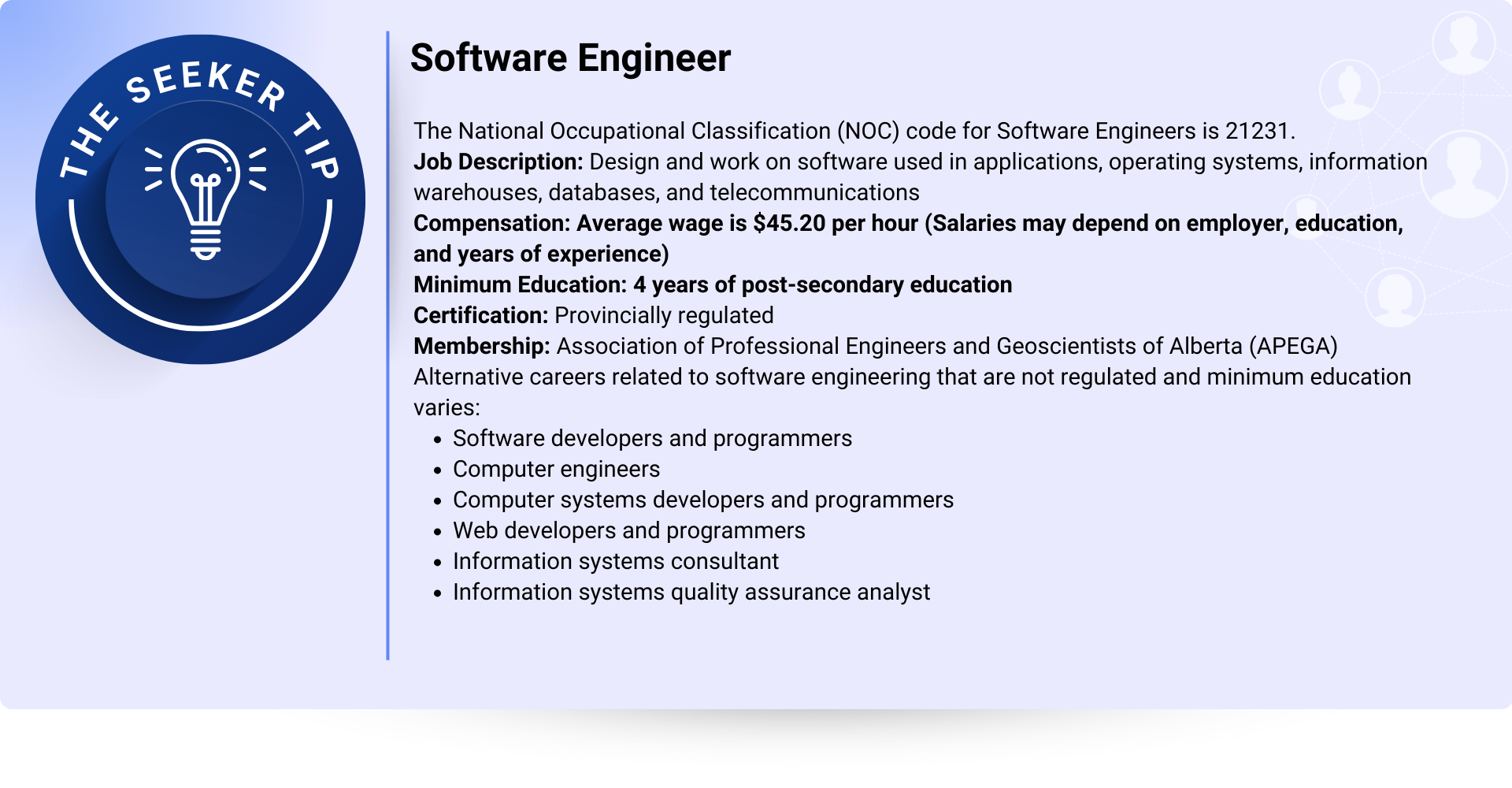
The 21231 NOC defines software engineers as professionals who research, design, evaluate, integrate and maintain software applications, technical environments, operating systems, embedded software, information warehouses and telecommunications software. They perform the following duties:
Analyze users’ requirements
Design and test software products or computer systems
Co-ordinate the development, installation, and operation of computer-based systems
Troubleshoot, upgrade and develop maintenance procedures for operating systems and applications
May lead and co-ordinate teams of information systems professionals
Skills
The Alberta Learning Information Service (ALIS) lists the following skills as key skills for Software Engineers working in Alberta:
Patience and persistence
Programming skills
A strong ability to learn new computer languages and other tech stacks
An aptitude for maths, science, and programming
Excellent speaking and writing skills
Attention to detail
Decision-making and problem-solving skills
The ability to teach others
Time-management skills
The ability to think logically and analytically
Teamwork skills
Education and Experience
The Association of Professional Engineers and Geoscientists of Alberta (APEGA) requires a 4-year bachelor’s degree in software engineering for certification. According to the Alberta Learning Information Service (ALIS), employers prefer software engineers who have a 4-year bachelor’s degree in software engineering. They also accept bachelor’s degrees in a related discipline, such as electrical engineering, computer engineering, or computer science. Many employers will accept an equivalent amount of work experience.
Qualifications
The APEGA licenses members (individuals) and permit holders (companies) to independently practice engineering and geoscience in Alberta. Non-Licensed individuals must work under the supervision of a member. The APEGA follows the Engineering and Geoscience Professions (EGP) Act.
APEGA Membership Types
Professional Member: designated as “Professional Engineer” (P.Eng), “Professional Geoscientist” (P.Geo.) or both. No limitation.
Requirements:
48 months of engineering work experience
Meeting of 22 key competencies
Valid References & Validators
Proof of Canadian Citizenship or Permanent Resident status
Proof of Identity
Competency in written and spoken English
Completion of the National Professional Practice Exam
Good character and reputation
Graduating from a university program that the Canadian Engineering Accreditation Board OR accredits is a related program that the Board of Examiners considers equivalent.
Professional Licensee: designated as a “Professional Licensee - Engineering” (P.L.(Eng)) or “Professional Licensee - Geoscience” (P.L.(Geo)). Limited to a clearly defined scope of engineering or geoscience.
Requirements:
At least two years of post-secondary education acceptable to the Board of Examiners (BOE) in a related practice
At least six years of professional-level work experience of an engineering nature that is acceptable to the BOE, under the direct supervision and control of a P.Eng., P.Geo., P.L.(Eng.), or P.L.(Geo.) with at least one of the required two years within the DSOP completed in Canada under the supervision and control of a P.Eng. or P.Geo. registered as an active member of APEGA during the supervision time period.
Sufficient valid references are required to reference all experience requirements fully
Passing score on the National Professional Practice Exam (NPPE). The NPPE is required for licensure but can be written at any time during the processing or review stage of the application.
Licensee: designated as a “Licensee”. Meets academic and experience requirements to be a professional Member but is not a permanent resident or Canadian citizen.
Requirements:
48 months of engineering work experience
1 year of equivalent Canadian work experience
Valid references
Passing grade on the National Professional Practice Exam
Graduation from a university program that the Canadian Engineering Accreditation Board OR recognizes is a related program that the APEGA Board of Examiners considers to be equivalent
Member-in-Training: designated as “Engineer-in-Training” (E.I.T.) or “Geoscientist-in-Training” (G.I.T.). Meets academic requirements but needs more experience to become a professional Member.
Requirements:
Must be of good character and reputation
Must have graduated from a university program that:
Is recognized by the Canadian Engineering Accreditation Board
Or a related program that the APEGA Board of Examiners considers to be equivalent
Internationally Educated Software Engineers
Credential Evaluation:
World Education Services (WES) is the only academic-assessment agency recognized by the APEGA, and only International Credential Advantage Package (ICAP) reports are accepted. A WES assessment that states you have a "4-year undergraduate degree" is only the first step in the academic assessment process. APEGA's Board of Examiners must also fully review the academic credentials.
WES ICAP Report:
Verifies the authenticity of your academic documents.
Establishes the equivalent level of your academic credentials compared with the Canadian university system
APEGA's Board of Examiners:
Review your degree to ensure it is a degree in engineering or geoscience.
Confirms the acceptability of the course content and performance of your degree.
Ensures that your degree meets the legal requirements for licensure.
Alberta Programs
Engineering and Technology Upgrading program at CCIS
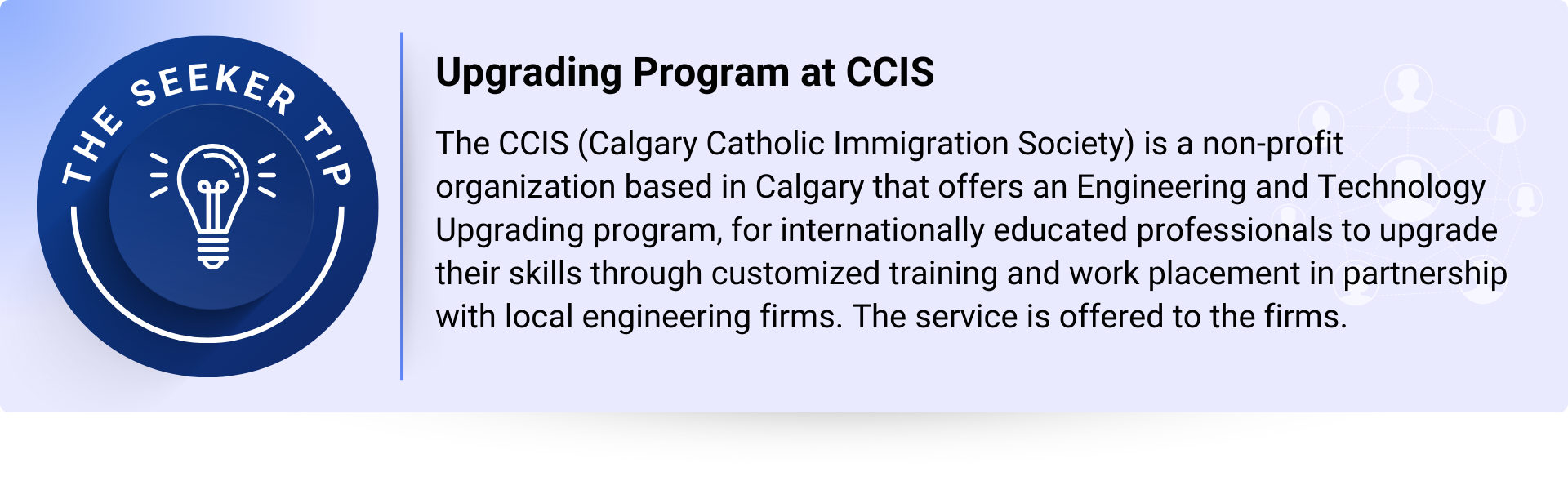
Information & Technology Bridging Program at CCIS: A 16-week training program offering 10 weeks of internship with reputable IT companies. In partnership with SAIT, this program provides foreign-trained IT professionals who have education and experience in the IT field, with the necessary soft and occupational skills training to equip them for the Canadian workplace better.
Requirements
Have prior international education and experience in the IT Sector.
An Employment Insurance (EI) recipient or has ended a claim for EI benefits within the previous 5 years.
Born outside of Canada and currently a Permanent Resident or Canadian Citizen.
Unemployed or underemployed and can demonstrate that they are actively seeking employment.
Willing to commit to full-time training leading to full-time employment in your field of training.
Resident of Calgary and surrounding areas.
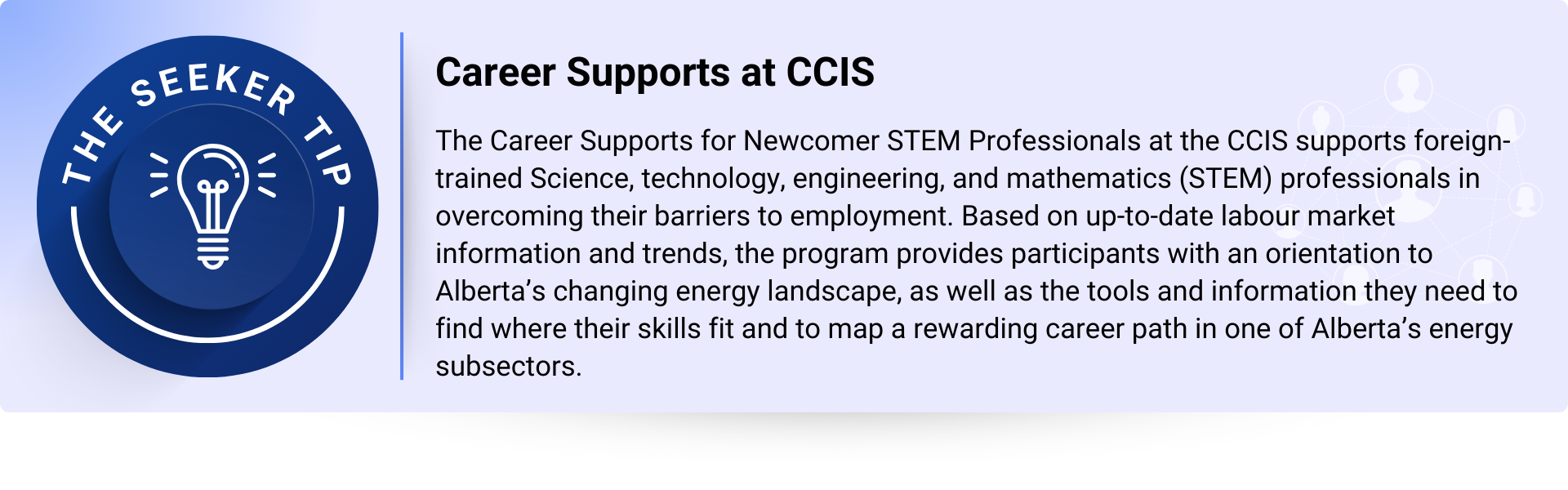
The Career Supports for Newcomer STEM Professionals at CCIS
Alternative Careers & Retraining
Software Developers and Programmers (NOC 21232)
Software developers and programmers design, write, and test code for new systems and software to ensure efficiency. A bachelor's degree in computer science or software engineering or another discipline with a significant programming component or completion of a college program in computer science or related field is usually required.
Computer Engineers (NOC 21311)
Computer engineers (except software engineers and designers) research, plan, design, develop, modify, evaluate and integrate computer and telecommunications hardware and related equipment and information and communication system networks, including mainframe systems, local and wide area networks, fibre-optic networks, wireless communication networks, intranets, the Internet and other data communications systems.
Computer engineers require a bachelor's degree in computer engineering, electrical or electronics engineering, engineering physics or computer science.
A master's or doctoral degree in a related engineering discipline may be required.
Licensing by a provincial or territorial association of professional engineers is required to approve engineering drawings and reports and to practice as a Professional Engineer (P.Eng.).
Engineers are eligible for registration following graduation from an accredited educational program, three or four years of supervised work experience in engineering and passing a professional practice examination.
Computer Systems Developers and Programmers (NOC 21230)
Computer systems developers and programmers write, modify, integrate and test computer code for software applications, data processing applications, operating systems-level software and communications software.
A bachelor's degree or college diploma program in computer science, computer engineering or in another discipline with a significant programming component.
Specialization in programming for engineering and scientific applications requires specific post-secondary study or experience.
Web Developers and Programmers (NOC 21234)
Web developers and programmers use a variety of programming languages to design, create and modify websites.
A bachelor's degree, usually in computer science, computer programming, web development or software engineering or completion of a college program in computer science or related field is usually required.
Experience as a computer programmer is usually required.
Resources
The Association of Science & Engineering Technology Professionals of Alberta
A self-regulating professional association that ensures public safety with a responsibility to guarantee the qualifications of those holding ASET titles and protect against title misuse, and the ability to exercise disciplinary and legal action to ensure the competence of ASET members.
Software Engineering Task Force (SETF)
Chaired by a member of the Canadian Engineering Qualifications Board, the task force is part of the Semantic Web Best Practices and Deployment Working Group of the World Wide Web Consortium (W3C) and investigates potential synergies between the Semantic Web and domains more traditionally associated with Software Engineering.
Engineers Canada upholds the honour, integrity, and interests of the engineering profession by supporting consistent high standards in the regulation of engineering, encouraging the growth of the profession in Canada, and inspiring public confidence.
Shastri Indo-Canadian Institute (SICI)
The Shastri Indo-Canadian Institute (SICI) is a unique bi-national organization mandated by the governments of India and Canada to promote, facilitate and nurture academic linkages, collaborations & exchanges, research partnerships, and networks on bi-national corridors.
Association for Computer Technology in Alberta
A not-for-profit Alberta organization that provides information on the IT sector and gives information to sector participants on education and support.
Technology Alberta exists to nurture a dedicated community of people and organizations whose coordinated and collaborative efforts help to make Alberta’s advanced entrepreneurial technology companies the global vendors of choice.
Alberta Artificial Intelligence Association (AlbertaAI)
A non-profit, non-political organization with a vision to cultivate the Alberta AI ecosystem and connect the Alberta AI community to the world.
A non-profit, member-based association that exists to nurture and support the growth of Alberta’s Internet of Things and emerging technology sectors.
Alberta Council of Technologies (ABCtech)
The Alberta Council of Technologies (ABCtech) advocates for commercializing disruptive technologies that will place Alberta and Alberta companies at the forefront of emerging economies.