Workplace Communication
There are patterns in the styles of communication in Canadian workplaces. This includes ways that workers express themselves, convey their needs, and interact with others. You can hone your Canadian workplace communication skills by paying attention to verbal and non-verbal cues, tone of voice and choice of words, and how you listen to others. Remember that communication styles vary depending on the industry, company, and individual preferences.
Communicating in Canadian Workplaces
Using Polite and Respectful Communication
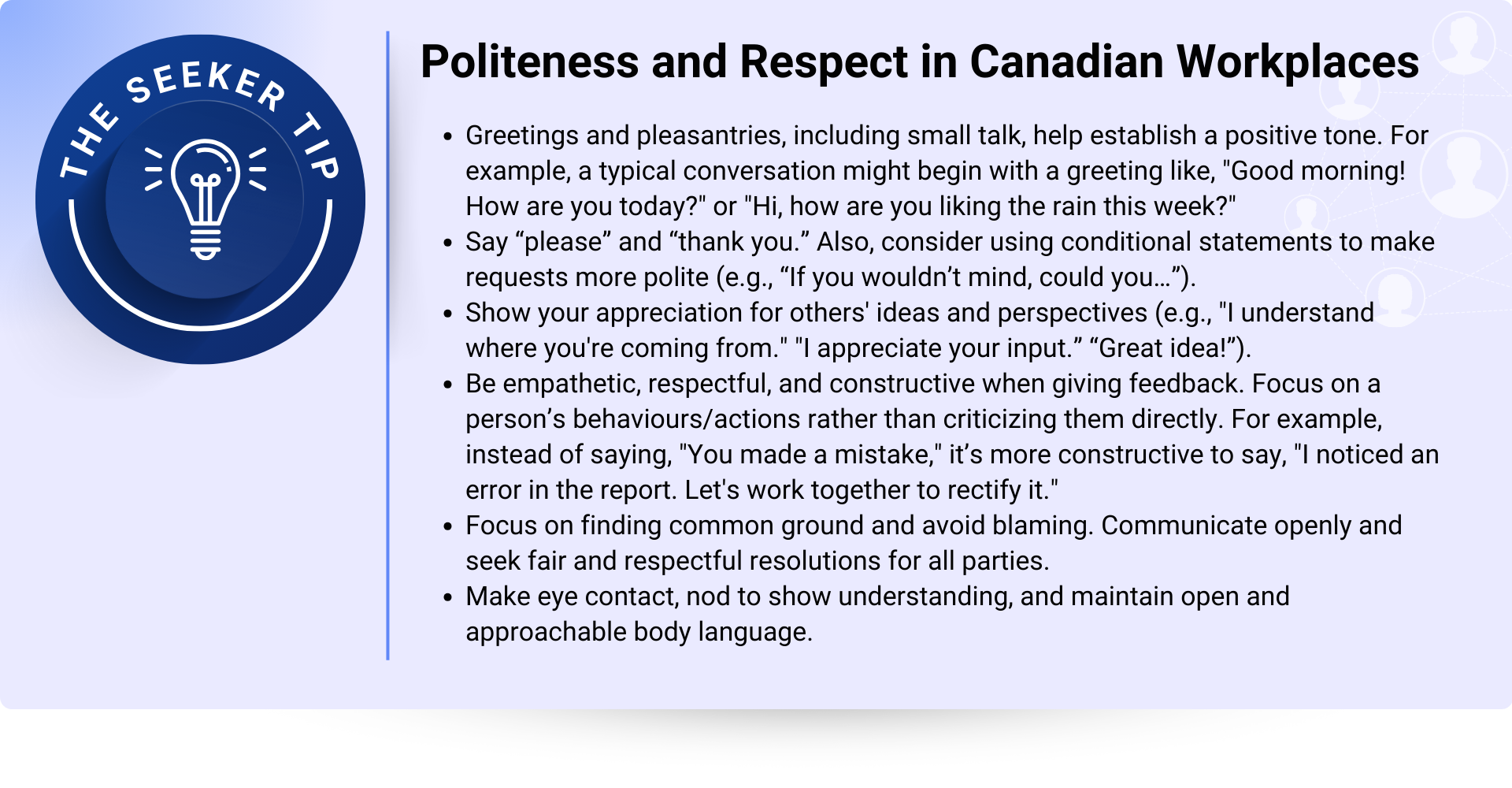
Politeness and respect play a significant role in workplace communication. Canadian workers maintain a courteous and respectful demeanour when interacting with colleagues, superiors, and clients.
Be Direct in your Communication
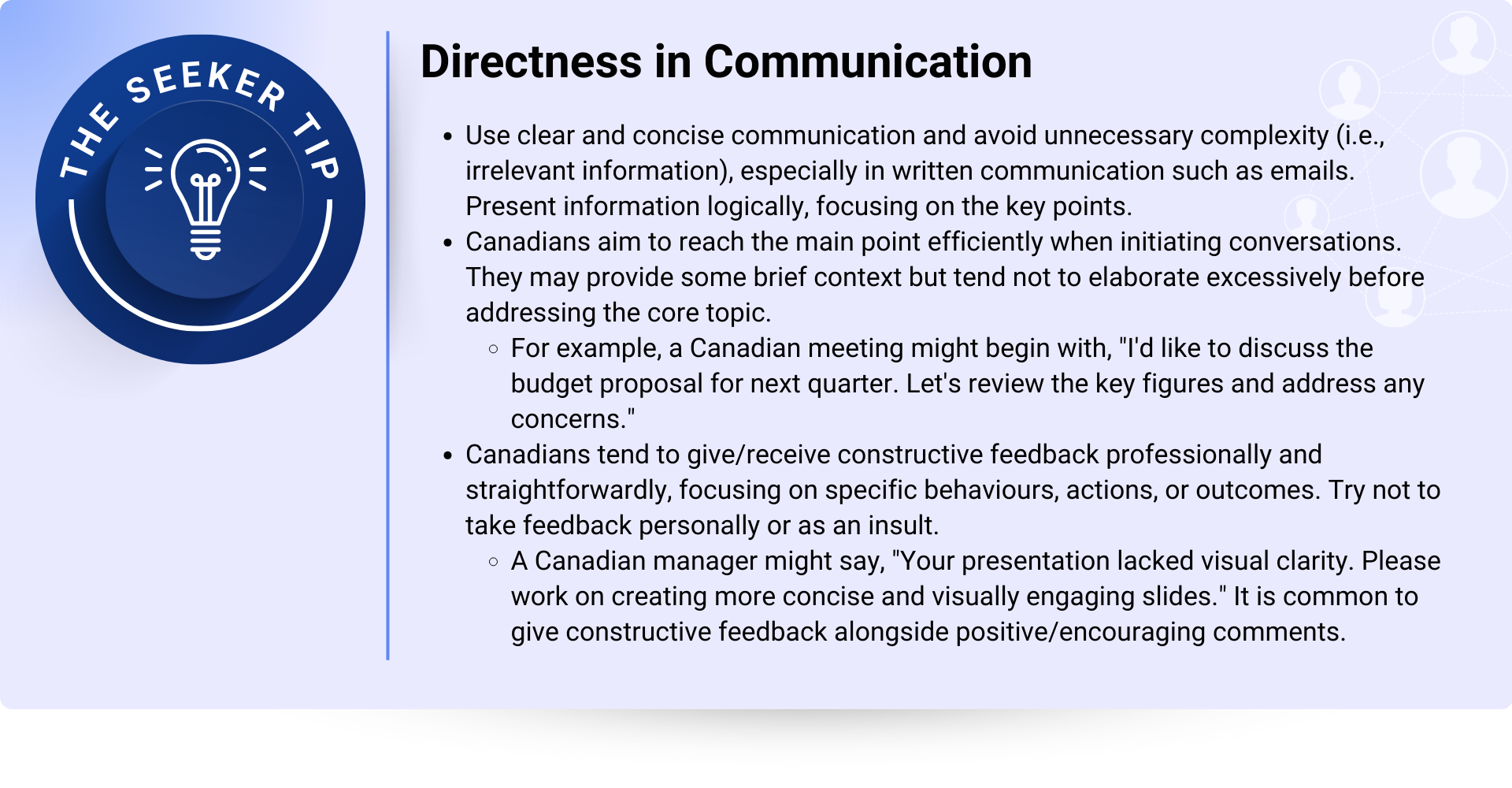
Being direct, clear, and forthcoming is an important aspect of communication in the Canadian workplace.
Communication in Teamwork and Collaboration
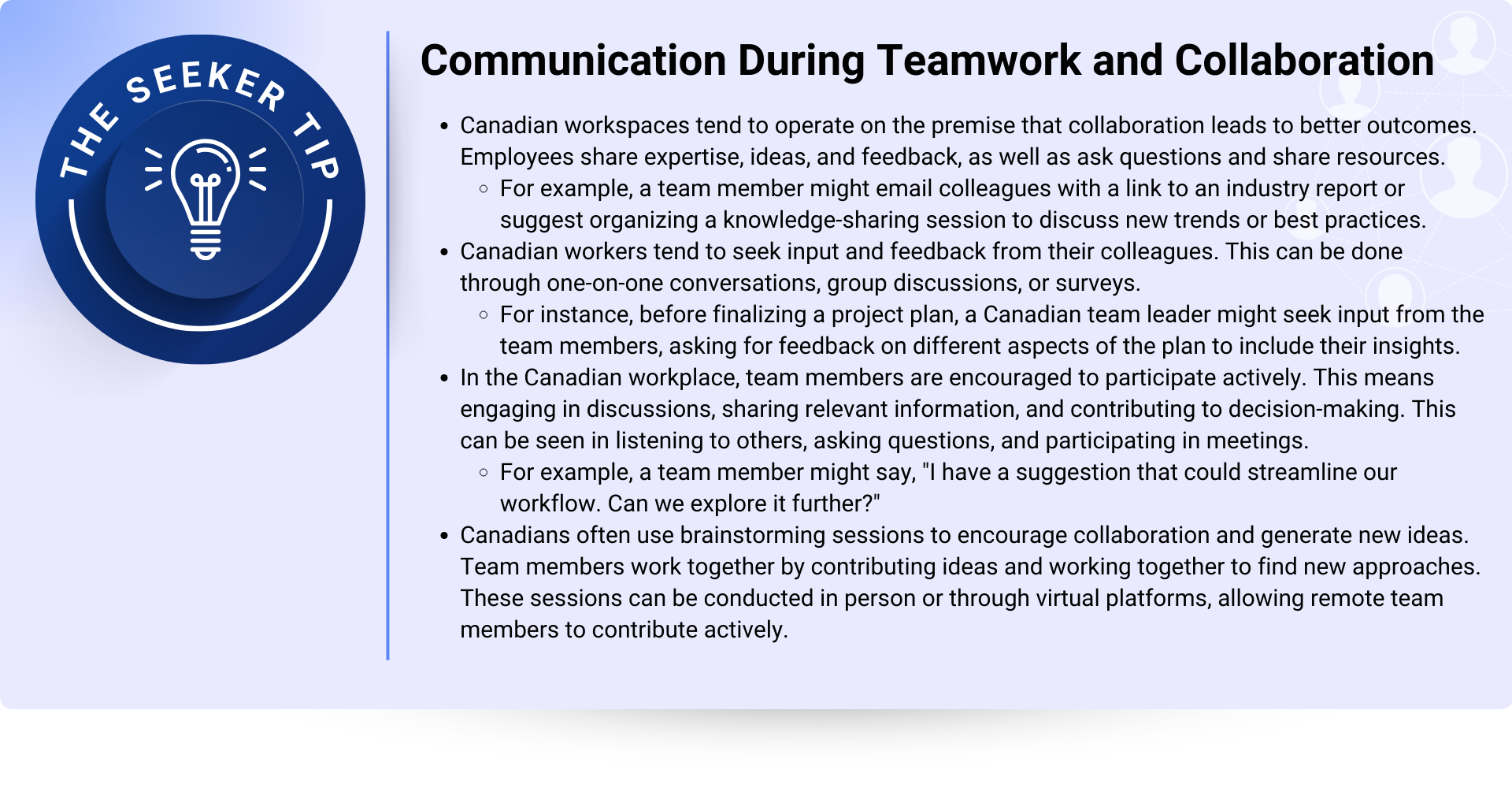
In the Canadian workplace, collaboration and teamwork are highly valued. Communication channels such as meetings, team huddles, or virtual gatherings facilitate idea sharing and open discussion.
I got my first job just 2 months after I landed in Canada. I had to work in a position lower than that I had in my own country which made me bored. I found it really hard to communicate with my colleagues as I was too afraid to offend anyone or say something I shouldn't, which caused people to think of me as a quiet and shy person. which I am not. After a year of working here, now I feel more comfortable to talk to people and share my stories. I am more confident with my job and I have been promoted to a higher position. I hope my experience can help others learn and grow and I have to admit, Canada offers the best diverse workplaces which enables individuals to express themselves freely.
-Shiva, Graphic Designer
Non-Confrontational Conflict Resolution
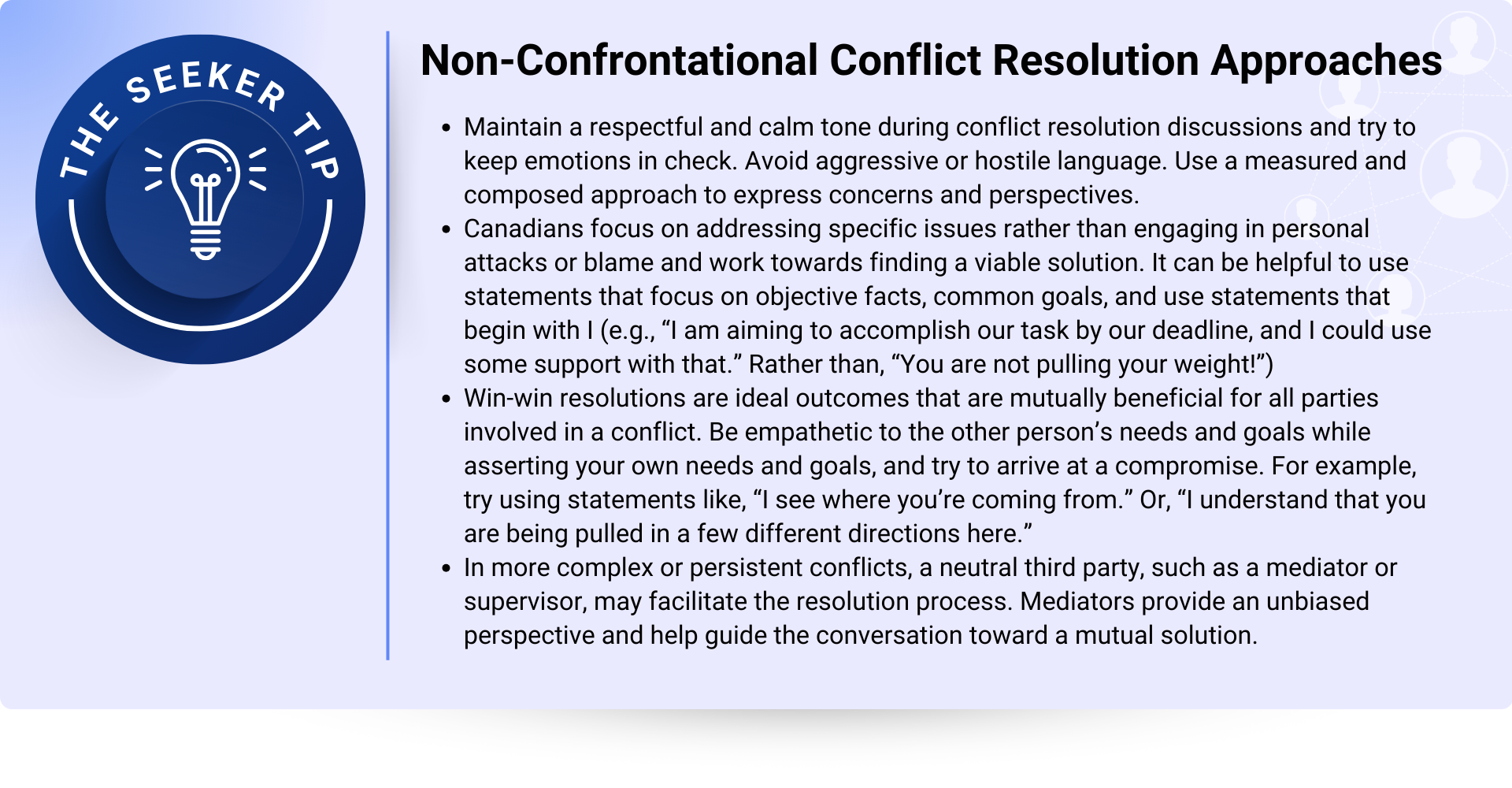
In the Canadian workplace, non-confrontational conflict resolution is a key aspect of communication style. It is advisable to avoid confrontational or passive aggressive communication when addressing conflicts or disagreements. Instead, opt for a more diplomatic approach, seeking common ground and aiming for win-win resolutions.
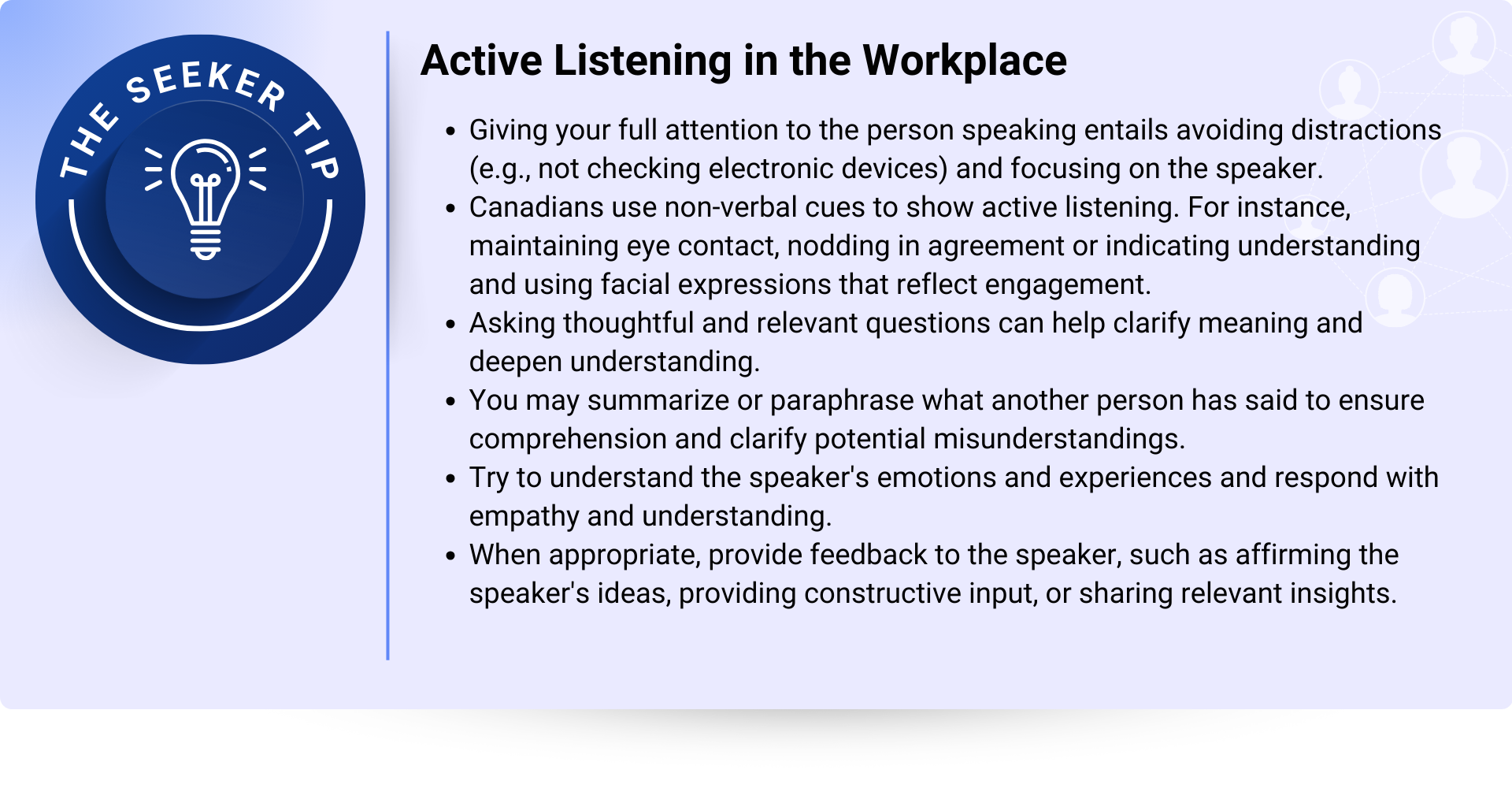
Active Listening as a Part of Communication
Active listening is a highly valued communication skill contributing to effective and meaningful interactions. In workplaces, colleagues typically demonstrate active listening by giving their full attention, showing genuine interest in other's perspectives, and asking relevant questions.
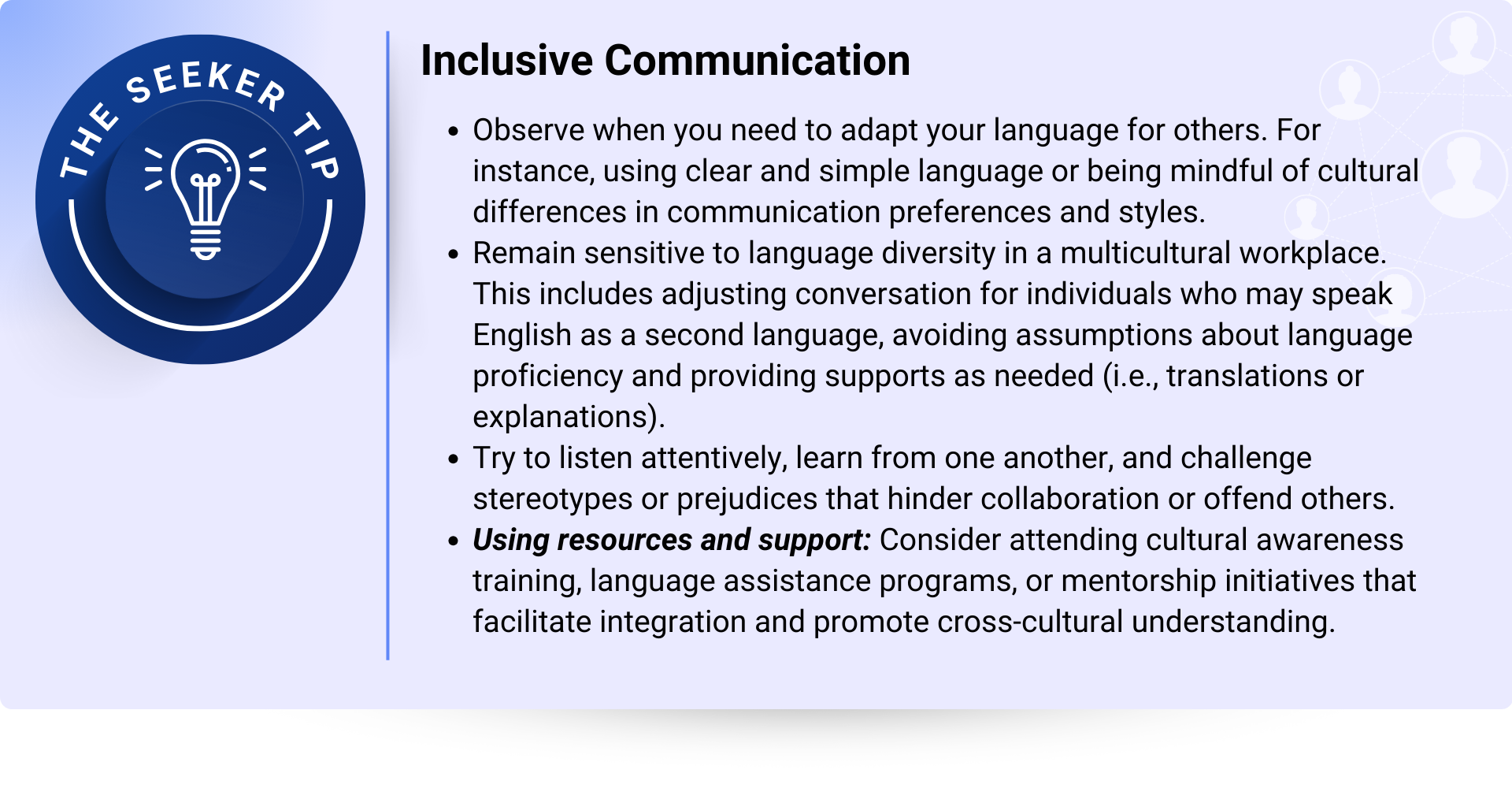
Inclusivity and Multiculturalism
In explicit and implicit ways, Canadian workplaces recognize diversity and multiculturalism. It is important to accommodate and respect diverse perspectives, backgrounds, cultures, and languages.
See The Seeker’s Workplace Language for more information on language that is inclusive to use in the workplace.
The following video suggests that there are four workplace communication styles. Consider your own style, and consider the styles that others prefer as you communicate with them.
Email and Written Communication
In the Canadian workplace, email is an important facet of efficient communication. In written communication like emails, Canadians value professionalism, conciseness, and clarity in their written communications.
Specifically, some characteristics of emails include:
CHARACTERISTIC | DESCRIPTION |
|---|---|
Professional tone | Maintaining a professional tone in written communications entails using formal language, addressing recipients appropriately, and adhering to workplace etiquette. |
Conciseness and clarity | Concise and clear writing in emails and other written communication entails using short sentences, bullet points, and subheadings so recipients can quickly understand the email's main point(s). |
Well-structured emails | Emails and written communications are typically structured logically and coherently. They have a short and informative subject line and begin with a clear statement of the purpose of the text. In the body of the email, ideas are grouped into paragraphs, often using headings or bolded text to highlight important details or action items. |
Professional salutations and closings | Common salutations include "Dear/Greetings (Recipient Name)." Common phrases for closing have "Sincerely," "Best regards," or "Thank you," followed by the writer’s name/signature. |
Proofreading and attention to detail | Proofreading or carefully reviewing helps ensure accuracy and clarity. It is important to take the time to review emails for spelling, grammar, and punctuation errors before sending them. |
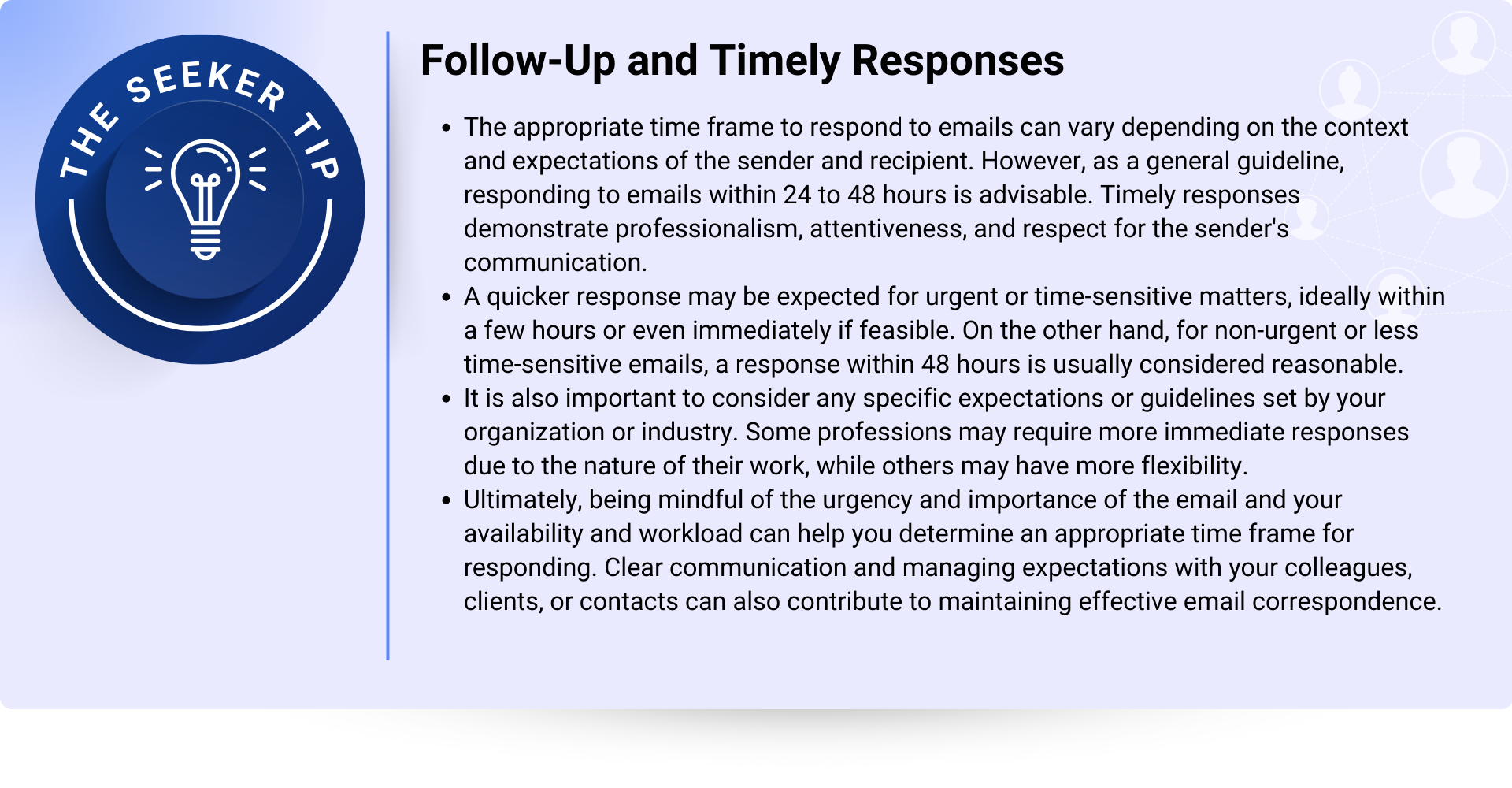
Follow-up and timely responses | Responding to emails promptly is professional, acknowledging receipt of the message and providing any necessary information or updates. |
Emailing Conventions
Conventions for emails will vary across workplaces and depend on your relationship with the recipient of your email. However, in general, the tone of a workplace email is expected to be courteous, polite, and respectful, and the message should be clear and concise.
This table outlines all the components of an email, along with examples:
COMPONENT AND DESCRIPTION | EXAMPLES |
Subject Line - A concise, specific summary of the email’s purpose or main topic. | Subject: Staff Meeting Reminder - June 20 at 2 PM One-pager Business Proposal Decision regarding your submission |
Send To - Enter the email address(es) of the recipient(s). If needed, you can add additional recipients in the fields for CC (Carbon Copy) and/or BCC (Blind Carbon Copy). CC is visible to all recipients, while BCC hides the recipients from each other. | CC: John, Sarah BCC: Manager, Stakeholders |
URGENT or Priority - Use these features (or include these words) to indicate that the email requires immediate attention or action. | Subject: URGENT - Critical System Issue [Under the ‘Priority’ below CC/BCC], select either ‘normal,’ ‘high,’ or ‘low’ |
Greeting/Address - Use an appropriate salutation, depending on the recipient(s). | Dear Mr. Root, Hello Dr. Jaloni, Good morning team, |
Introduction - Set the tone with a polite and professional opening sentence. | I hope this email finds you well. I hope your week is off to an excellent start. |
Body Clearly state the purpose of the email, provide relevant details and organize information logically. Use paragraphs or bullet points if it would help with clarity and readability. The body may be a good point to mention if anything is attached that the recipient should look at. You may also mention any actionable items or expected responses that you need from the recipient. | I wanted to follow up on our previous discussion and share the updated timeline for the project. Here are some key dates: - Date 1 - Date 2 I am writing to ask if you would consider serving as a task force member for inclusive language in the workplace. I’ve attached a summary of the task force's objectives and responsibilities. Please look this document over and let me know if you have questions. I will need your decision by July 3. |
Closing - End the email with a polite closing remark. | Thank you for your attention to this matter. I appreciate your assistance/consideration in advance. I am looking forward to your response. |
Sign off - Use an appropriate closing phrase. | Best regards, Sincerely,
|
Signature - Include your full name, job title, and contact information. | Emily Johnson Project Manager, Solutions Enterprise Phone: (444)123-4567 Email: ejohnson@solutions.ca |
Here are some examples of workplace emails that feature the above components:
Subject: Request for Proposal Submission Deadline Extension
Dear Ms. Johnson,
I hope this email finds you well. I am writing to request an extension for the submission deadline of our proposal for the upcoming project.
Due to unforeseen circumstances, our team has encountered unexpected delays in completing the necessary research and analysis. A two-day extension would allow us to complete a comprehensive and high quality proposal. Accordingly, if you agree, we will submit the proposal on Tuesday, September 21.
Thank you for your understanding and consideration. We greatly appreciate your support and look forward to submitting our proposal by the revised deadline. Should you have any questions or require further information, please do not hesitate to contact me directly.
Sincerely,
[Your Name]
[Your Position]
[Your Company]
Subject: Follow-up on Meeting Action Items
Dear Ms. Johnson,
I hope this email finds you well. I am following up on our meeting with a project update. I have compiled a summary of the action items and next steps for your reference.
Project Status Update: Milestones achieved: Completed Phase 1 ahead of schedule. Challenges: Identified a potential resource constraint for Phase 2. Mitigation plan in progress.
Revised Timeline: Phase 2 start date: August 15th, 20XX. Completion target: November 30th, 20XX.
Budget Considerations: Additional funding request approval: Submitted to the finance department.
Resource Allocation: Assignment of an additional team member: Pending HR's finalization. Expected confirmation by the end of this week.
Next Meeting: Proposed date and time: Wednesday, August 4th, at 10:00 AM. Meeting agenda: Review resource allocation, discuss mitigation plan, and address outstanding concerns.
Please let me know if there are any modifications or additional items you would like to discuss during our next meeting. Please let me know if you have questions or require further clarification. I look forward to our next meeting.
Sincerely,
[Your Name], Project Manager
Informal Communication
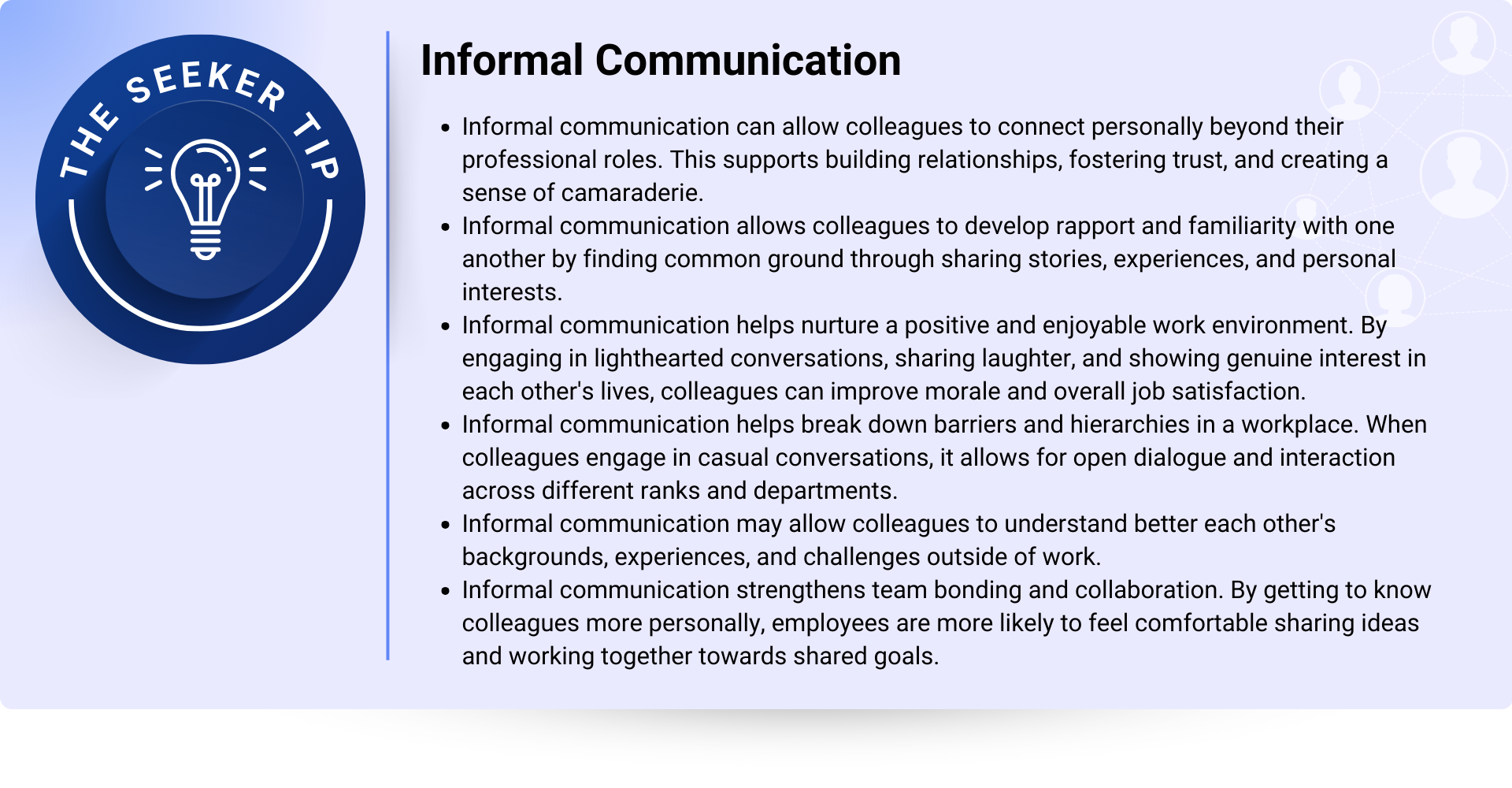
Informal communication is an inherent part of workplace communications. During breaks or social events, colleagues engage in casual conversations (while maintaining professionalism) that help them develop rapport and strengthen connections. Informal communication is part of how Canadians build relationships and foster a positive work environment.
Resources
Discover Canadian Communication Style
This interactive online resource, designed by English and Immigration, outlines English grammar and vocabulary that can support your understanding of how Canadians typically communicate.
Udemy Communication Skills Courses and Tutorials
Browse various communication skills courses for personal and professional contexts. Udemy offers free learning as well as paid courses.
Coursera Improving Communication Skills Course
Enrol for free in this online course focusing on communicating effectively in the workplace and achieving your goals.
The Workplace Online Retention Class (WORC) | The Immigrant Education Society
In WORC, you will complete activities and lessons online. Each week, you will complete 2.5 hours of homework on English for employment purposes. WORC is delivered through the TIES|Learn online education system, which can be accessed here.
See the culture-specific information and resources to highlight communication style differences for: Filipinos, Indians, and Ukrainians.
Also, The Seeker provides profession-specific information and resources to highlight communication styles specific to Nurses, IT Professionals, and School Teachers.