Workplace Culture
This page lists scenarios and examples highlighting the variations in workplace norms and expectations between Filipino and Canadian contexts that you might encounter as you transition to your chosen profession in Canada. This page also discusses how professional relationships may differ in Filipino and Canadian contexts. These differences are rooted in work practices, organizational structures, and societal norms. Understanding and respecting these cultural norms can help you adapt your behaviour and communication style as you transition your professional life from the Philippines to Canada.
Norms in the Workplace: Some Differences Between the Philippines and Canada
SCENARIO | 🇨🇦TYPICAL CANADIAN WORKPLACE | 🇵🇭TYPICAL FILIPINO WORKPLACE |
Addressing supervisors | Use of first names and relatively informal language. | Use of first names and informal language. Use of formal language, respect markers, and titles such as Ma’am, Sir, and po. |
Workplace management | Managers assign tasks to employees but expect them to participate, engage, and make suggestions actively. | Managers assign tasks, and employees closely follow their directions. |
Making group decisions | Group decisions are made together, typically by majority or consensus, often in a timely and efficient manner. | Decision-making powers lie mostly with those in higher positions. Employees may not provide their opinions or suggestions unless directly asked. If the group decides together, the goal is often to reach a consensus. |
Meetings and appointments | Meetings begin quickly and adhere closely to a prepared agenda. | Building strong relationships between co-workers is very important. Even if meetings have officially started, there are often informal discussions regarding family or personal activities. |
Completing tasks and meeting deadlines | Canadian employers and colleagues prioritize effective time management and prompt delivery of results. | Deadlines may be perceived as flexible, and there might be a tendency to prioritize relationships and flexibility over strict schedule adherence. |
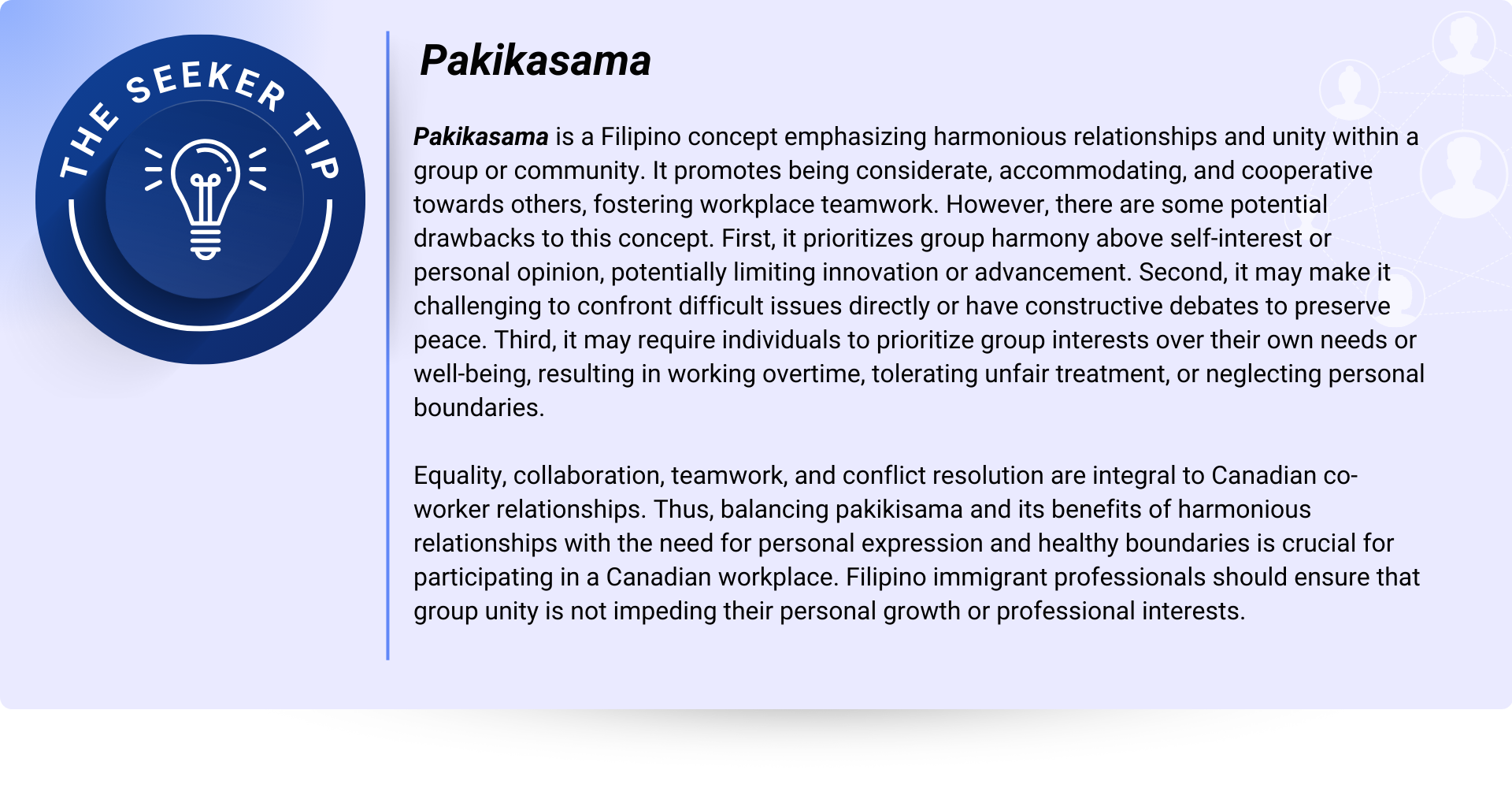
Conflict resolution | Employees directly address conflicts and issues with co-workers. | Being mahiyain (reserved or shy) and practicing pakikisama (ensuring group harmony) may mean an indirect approach to solving problems. Employees may approach their superiors to help resolve conflicts in line with a hierarchical structure. |
Different Leadership Styles
🇵🇭Philippines: Filipino workplaces typically follow a hierarchical leadership style where the authority and decisions of superiors are rarely questioned. Employees follow their guidance on how to complete the task closely. Suppose the leader is looking for their employees’ ideas or suggestions. In that case, they may need to initiate it because of the Filipino aversion to drawing attention to themselves or appearing boastful and arrogant (mayabang). As such, Filipinos are generally perceived to be more reserved (mahiyain) at work.
Example: The department head approaches their team members to ask if they have any ideas on how adopting new technologies can improve productivity.
Age-based hierarchy is deeply rooted in the culture of the Philippines. This is evident in interactions with an elder, exemplified best in the practice of mano, a greeting done by pressing an elder’s hand to the younger person’s forehead. This power structure is also sometimes reflected in the workplace where older people, often regardless of experience, are higher in the hierarchy than younger employees. In many cases, younger colleagues who give orders or correct older colleagues are seen as disrespectful. So, someone’s age can determine how a co-worker is addressed or spoken to. Therefore, asking a colleague about their age is commonly one of the first questions in a new job.
🇨🇦Canada: In egalitarian structures, employers expect the input and contribution of employees in addition to completing their assigned tasks. In Canada, showing initiative is an important soft skill that signifies an employee’s professionalism, adaptability, decisiveness, and problem-solving skills.
Example: A team member approaches the department head about new technologies
and presents the various ways it could be used in the office.
The Canadian workplace is more collaborative and values the input of colleagues in different positions in the company regardless of age. Co-workers should listen and participate in meetings and discussions regardless of any existing age differences. This means that age is less important, and asking a colleague how old they are at the initial stages of the relationship is unusual.
Decision-Making
🇵🇭Philippines: In Filipino culture, decision-making may involve seeking input and consensus from multiple stakeholders. Group harmony is prioritized, and decisions may be reached through discussions and seeking consensus. Filipinos engage in extensive discussions to ensure everyone’s opinions are considered before deciding.
🇨🇦Canada: Canadian workplaces often emphasize efficiency and timely decision-making. While collaboration is valued, decisions may be made by individuals or smaller groups responsible for the specific area, with less emphasis on seeking consensus from all stakeholders to focus on deciding on time.
Work-Life Balance
🇵🇭Philippines: Filipinos value work-life balance and prioritize family and personal commitments alongside work responsibilities. They may place importance on spending time with family and participating in social or religious activities. Filipino employees seek flexibility in their work schedules.
🇨🇦Canada: While work-life balance is also valued in Canada, there may be a stronger separation between work and personal life. Canadians typically prioritize completing their tasks during work hours and allocate personal time for family, hobbies, or leisure activities.
Attitudes
🇵🇭Philippines: Filipinos may have a more relaxed approach to time management. Deadlines may be perceived as flexible, and there might be a cultural tendency to prioritize relationships and flexibility over strict schedule adherence. This doesn't mean that tasks are not taken seriously or that deadlines are disregarded entirely. Still, there may be a greater emphasis on adaptability and reprioritizing tasks based on emerging needs or unexpected circumstances. Communication of urgency may also be more nuanced, focusing on maintaining harmonious relationships and considering the broader context and specific circumstances when discussing timelines and priorities.
Example: The initial deadline of two weeks to develop a new advertising campaign is extended due to an unforeseen personal matter involving one of the team members.
🇨🇦Canada: Canadians typically have a strong sense of urgency when completing tasks and meeting deadlines. Efficiency and timeliness are highly valued, and there is an expectation that work should be completed promptly, as deadlines are set with the expectation that they will be met. Canadian employers and colleagues often prioritize effective time management and prompt delivery of results and there is a direct and explicit communication of urgency regarding tasks and deadlines. Urgent requests or time-sensitive issues are often addressed promptly to meet the needs of clients, stakeholders, or colleagues.
Example: The initial deadline to develop a new advertising campaign is met despite an unforeseen circumstance, largely because the work was completed early.
Punctuality
🇵🇭Philippines: Filipino culture is known as "Filipino time," which refers to a more relaxed attitude toward punctuality. It is common for meetings and events to start slightly later than scheduled, and lateness may be more accepted or tolerated than in other cultures. This cultural norm stems from various factors, including traffic congestion in urban areas, unpredictable transportation conditions, and a more laid-back approach to time management. It may also be rooted in the Filipino emphasis on maintaining harmonious relationships and avoiding conflict. Thus, it is common for attendees to engage in casual conversations or socialize while waiting for others to arrive, as this builds rapport and fosters a friendly atmosphere. However, it is important to note that not all Filipinos adhere strictly to "Filipino time," some prioritize punctuality and value efficiency in their work environments.
Example: If a meeting is scheduled to start at 9:00 AM, it is not unusual for participants to arrive gradually over the next 15 to 30 minutes, engaging in friendly conversations and informal interactions while waiting for everyone to arrive. The meeting officially commences at around 9:15 AM, with participants sharing updates and ideas in a relaxed and conversational manner.
🇨🇦Canada: Canadian workplaces generally prioritize punctuality and expect participants to adhere to meeting and event start times. Arriving on time or slightly early signifies professionalism and respect for others' time. Timeliness is highly valued to ensure efficient use of resources, maintain productivity, and demonstrate commitment to the work at hand.
Example: In a Canadian workplace, a team meeting is scheduled to start at 9:00 AM. Participants consciously try to arrive on time or a few minutes early. The meeting begins promptly at 9:00 AM, with participants diving straight into the agenda, discussing action items, and exchanging ideas in a focused and efficient manner.
See The Seeker’s general guide on workplace culture for more information. Also, see “Your Rights in the Workplace” to learn about your labour rights and how to protect them.