Workplace Language
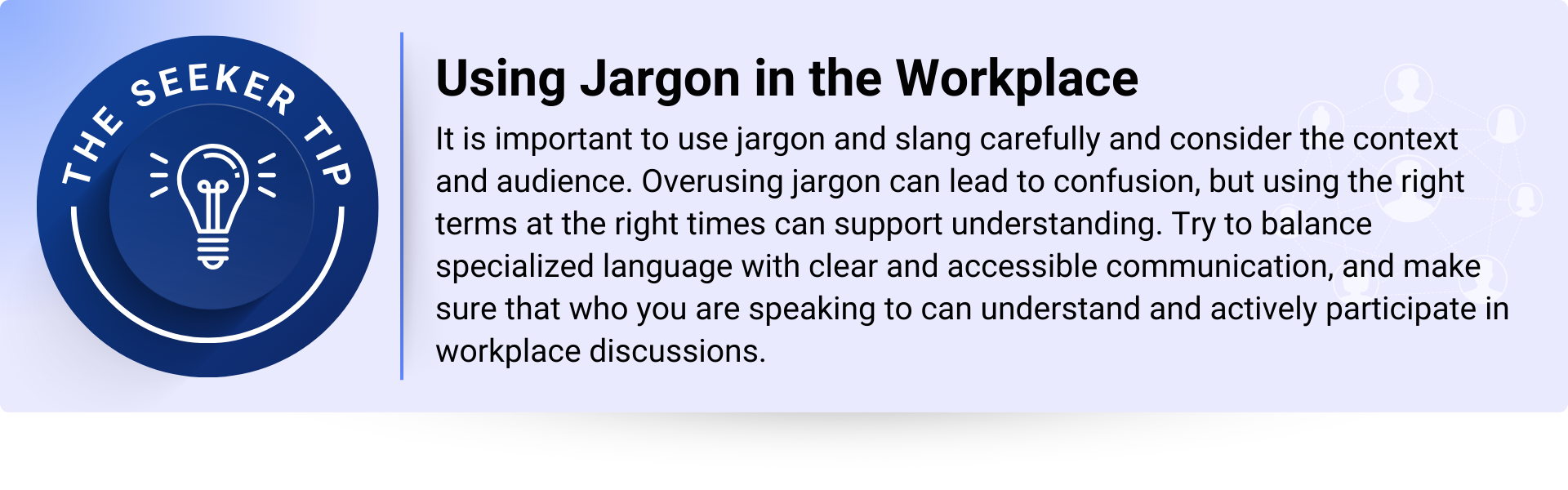
Professional workplaces feature regular communication between colleagues, supervisors, and managers. Communication bolsters healthy collegial relationships and can contribute to your success and sense of belonging in your organization or profession. Workplace communication often includes jargon, which includes specialized slang, idioms, and expressions that are specific to a particular workplace, profession, or group. Getting used to jargon in a new workplace, culture, or language may take some time. This page provides an overview and some examples of workplace terminology, jargon, and slang in Canadian workplaces.
Jargon in the Workplace
Your colleagues in Canadian workplaces may use jargon, slang, and idioms for various reasons, including:
Efficient Communication: These terms and phrases comprise shorthand or specialized vocabulary that can quickly convey meaning among professionals within the same field. It allows people to communicate complex ideas or concepts succinctly.
Inclusivity and Connection: Using jargon or slang can create a shared sense of belonging among colleagues in the same field or discipline. It fosters a feeling of unity and understanding within a specific professional community.
Industry-specific Terminology: Many professions use unique terminology essential for effective communication. Using industry-specific jargon helps professionals accurately convey information and ensures clarity when discussing technical aspects of their work.
Expertise and Professionalism: Using jargon and industry-specific language can demonstrate expertise and professionalism. It signals to others that an individual is knowledgeable in their field and can effectively communicate with peers.
Efficiency in Training and Onboarding: Jargon can be helpful during training and onboarding processes. It allows new employees to quickly learn and integrate into the work environment, reducing the need for lengthy explanations.
This table presents slang, jargon, and idioms that immigrant professionals might come across:
WORD/PHRASE | MEANING | EXAMPLE |
Actionable items | Tasks assigned to employees that can be accomplished shortly contribute towards completing a project. | The manager created a list of actionable items for the week, including preparing a report draft and contacting stakeholders for input. |
(Be) ahead of the curve | Advanced thinking compared to other people or companies. | The industry values individuals who are ahead of the curve in technological advances. |
ASAP | An acronym for ‘as soon as possible.’ | Please complete the form ASAP and return it by email. |
(Be) all ears | To listen with full attention. | If you have any suggestions, I am all ears. |
Put it on the back burner | To postpone or delay something that is of low priority. | Let’s put this task on the back burner for now and focus solely on the proposal. |
Go back to the drawing board | To start over because of a failed idea or plan. | The proposal was rejected, so they need to go back to the drawing board. |
Bail | To leave or give up on a commitment or activity. | The clients bailed on us at the last minute. |
(Be) beat | To be tired or exhausted. | I am beat, so I am going home to rest. |
Been down this/that road before | Indicates that someone has had a similar action or experience in the past. | We’ve been down this road before; we know how clients will react. |
The big picture | A broad, complete overview/ perspective of a situation. | We have to consider the big picture. How will this affect our long-term goals? |
The bottom line | The most important result or consideration of a situation. Points to an underlying reality of a situation. | The bottom line is that we cannot complete the work by the deadline. |
Brainstorm | A group discussion of ideas and suggestions to come up with ideas or to find solutions to problems. | We will hold a brainstorming session at our Friday meeting. |
By the book | To follow the rules very closely. | The manager ensured everything was done by the book, following every company policy carefully. |
Call it a day | To stop a work or activity period whether or not it is completed. | We decided to call it a day because it was getting late. |
Circle back | To come back and discuss or reconsider at a later time. | Let’s each explore some options individually and circle back to discuss this later. |
Close call | A narrow escape from something, typically an unfavourable situation. | We almost missed the deadline, but Fatima finished the proposal on time. It was a close call. |
Cut corners | To complete something using the fastest or easiest way, often by ignoring rules or sacrificing the quality. | The team had to cut corners to complete the task on time; they only contacted half the stakeholders they had planned to contact. |
Do a deep dive | A detailed investigation or assessment of a topic. | I was asked to do a deep dive on companies offering similar services to us. |
Get (one’s) ducks in a row. | To prepare or organize before an event/meeting. | We must get our ducks in a row before meeting with the client next week. |
Game changer | A technology, idea, person, or event makes a big difference to a situation. | The new software was a game changer in the industry; it made our work much more efficient. |
Get (someone) on board | To convince someone to participate/agree. | It was difficult to get Ari on board because they are so busy these days with other projects. |
Get (something) off the ground | To begin/launch something. | They struggled to get the project off the ground. |
Get the ball rolling | To start an activity or process, to take the first step(s) to accomplish a task. | The researchers conducted a literature review and interviewed two experts in the field to get the ball rolling for their project. |
Go the extra mile | To do more than what is required to achieve something. | The clients were impressed that the company would go the extra mile to resolve the issue. |
Heads-up | To warn or inform someone that something is happening. | Our manager gave the staff a heads-up about the upcoming performance reviews. |
Higher-up | A person in a company organization who holds a superior position. | We are awaiting approval from the higher-ups. |
Keep up with the times | To adjust to new circumstances or stay current. | The companies incorporated new technologies to keep up with the times. |
Learn the ropes / Show (someone) the ropes | To learn or teach someone the appropriate procedure to complete a task. | I needed a few weeks to learn the ropes at my new job. |
Level the playing field | To ensure that the circumstances are fair for everyone. | Applicants who needed extra assistance with learning disabilities were provided extra support to level the playing field. |
Low-hanging fruit | Something that can be quickly finished or obtained. | We need to recruit volunteers, so let’s go for low-hanging fruit first by asking our employees. |
No-brainer | A decision that requires little thought or effort. | The job offer exceeded all her demands, so accepting the offer was a no-brainer. |
Not going to fly | Something that will not be approved/accepted or that will not work/succeed. | Having a poor attitude is not going to fly with the new boss. |
On the same page | Agreement about how something is or should be done. | The department heads were not on the same page about how they wanted to move forward. |
One-pager | A single-page summary document. | The clients asked for a one-pager overview of our services. |
Pick your brain | To ask questions to obtain information or suggestions. | Can I pick your brain about the ABC Project? |
Props | To give credit or recognition to someone for their work. | Props to everyone who organized this event; it was a success! |
Reinvent the wheel | To use time and effort on something already done by someone else. | Instead of attempting to reinvent the wheel, review what past successful marketing campaigns have done. |
Take (something) at face value | To accept something as it is without question or doubt. | Given their previous success, we can safely take what they say at face value. |
Take the bull by the horns | To deal with a complex and undesirable situation confidently and directly. | Since she was the only one with experience dealing with similar crises, she had no choice but to take the bull by the horns. |
Take it easy | To relax or be calm. | I will take it easy this weekend after a busy week. |
In the loop / Out of the loop | Having (/ or lacking) knowledge about something. | I will ‘CC you on all emails so that you stay in the loop. / After his demotion, he was kept out of the loop regarding major decisions. |
Think outside the box | To explore ideas that are innovative and unconventional. | They encouraged me to think outside the box to come up with original ideas and stand out from the other businesses. |
Throw (someone) under the bus | To place blame on, or punish, another person to ensure self-preservation. | It’s unfair that my coworker threw me under the bus when the client was unhappy - we both worked on the project. |
Time is money | Time is a valuable resource; saving time and doing things as quickly as possible is best. | Let’s do this more efficiently by emailing everyone together rather than one-by-one. Time is money, afterall. |
Touch base | To reconnect or contact someone. | Let’s touch base next week to discuss the updates. |
Silver bullet | Something that is a perfect solution for an unpleasant problem. | There’s no silver bullet here, but the recommendations are the best way to tackle workplace conflict. |
Under the weather | To feel ill or unwell. | Maria was feeling under the weather, so they cancelled the presentation. |
Up to speed (Bring up to speed) | To possess all the necessary knowledge and information. | New employees must be brought up to speed on all our current projects. |
Win-win | A situation that has beneficial outcomes for everyone involved. | Each side got what they wanted. It’s a win-win deal. |
Word of mouth | Informal verbal communications. | I discovered that we hired a new marketing representative by word of mouth. |
Euphemisms in the Workplace
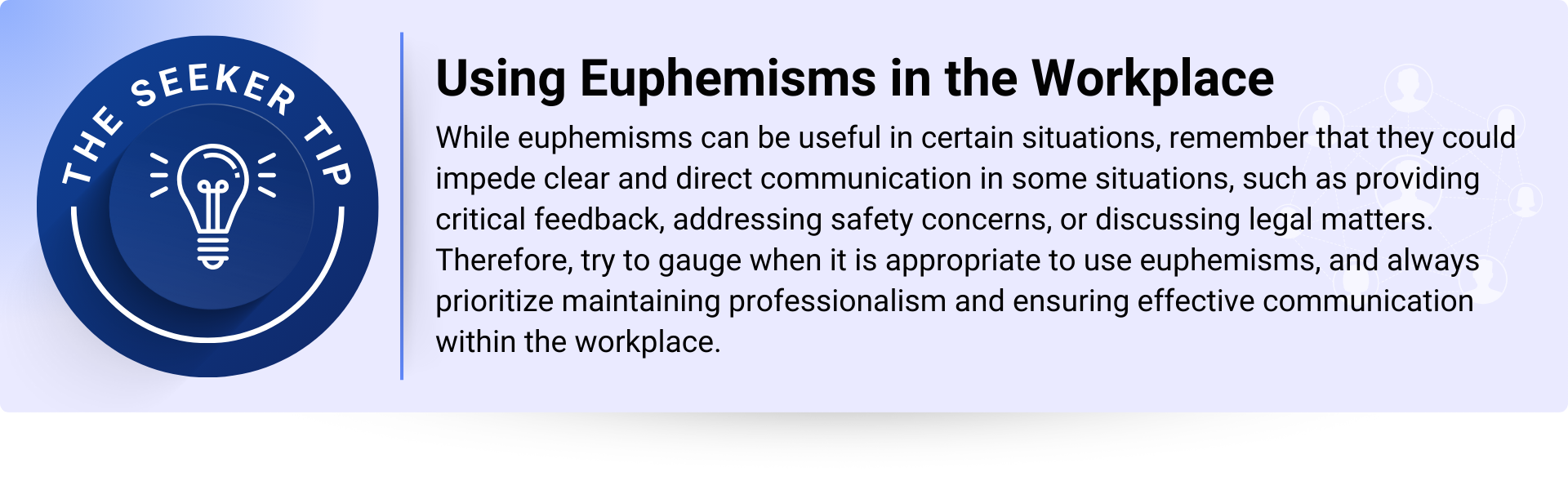
Euphemisms are ways of saying things that avoid being overly direct, unpleasant, or even offensive. Euphemisms soften the harshness of certain topics, and help make communication more polite, tactful, or socially acceptable in formal settings during sensitive discussions and for taboo topics.
Here are some reasons that euphemisms are used to communicate in Canadian workplaces:
Softening Negative or Sensitive Language: Euphemisms can replace harsh or blunt language with more tactful or diplomatic expressions. They help deliver potentially difficult messages with more sensitivity or discretion.
Maintaining Professionalism: Euphemisms allow people to communicate professionally while maintaining a respectful and appropriate tone. They help navigate uncomfortable or controversial topics in a more neutral or less confrontational way.
Promoting Positive Workplace Culture: Using euphemisms can contribute to fostering a positive and inclusive work environment. Euphemisms often focus on solutions, cooperation, and constructive feedback rather than criticism and assigning blame.
Managing Emotions and Conflicts: Euphemisms can be helpful in diffusing tense or emotional situations because they feature neutral or non-confrontational language. They can facilitate open communication and promote conflict resolution without escalating tensions.
Cultural Sensitivity and Respect: Euphemisms often accommodate diverse cultural backgrounds and avoid potential misunderstandings or offence. They can help bridge language or cultural gaps, improving cross-cultural communication and understanding.
Enhancing Professional Image: Using euphemisms can contribute to a polished and professional image. They demonstrate an individual's ability to communicate effectively and handle delicate matters with tact and discretion.
This table presents euphemisms you may encounter in Canadian workplaces:
EUPHEMISM | MEANING | EXAMPLE |
More formal: - To let someone go / To relieve someone of their duties (Be) fired/canned | To terminate someone’s employment. | I’m sorry, Bryce, but I will have to let you go. / Apparently, Bryce was fired last week. |
Downsizing / Layoffs | To make a company/organization smaller by eliminating staff positions (and often terminating some employees). | Unfortunately, there will be downsizing next spring. Corporate said there will be layoffs - about 10% of the company will be laid off. |
Work-life Balance | This phrase promotes a healthy equilibrium between work and personal life. | One of the reasons I love this job is the work-life balance. I never feel obligated to check my work emails after 5:00 PM. |
Enhancing the truth / Stretching the truth / Embellishing | These phrases suggest someone is providing exaggerated, false, and/or misleading information. | He was accused of stretching the truth about how much he was involved in the project. |
Strategic (re)alignment | This term is used to describe changes in organizational structure or operations. | The project is moving in too many different directions, so I propose we meet to discuss the strategic realignment of our objectives and resources. |
Optimize / Streamline | This phrase refers to improving efficiency or eliminating unnecessary expenditures and redundancies. It may include efforts to cut costs or reduce expenses. | We are wasting our energies with the current workflow process; we need to streamline our approach to optimize our outputs. |
Unforeseen circumstances | A term used to vaguely describe an undisclosed reason that things didn’t go as planned. | Due to unforeseen circumstances, we could not meet our deadline. |
Constructive feedback | A type of feedback aimed at achieving positive outcomes by providing someone with comments, advances, or suggestions that will be useful to (and improve) their work in the future. This is a friendlier term to use than ‘criticism.’ | In my performance meeting, my manager reviewed some of my strengths and provided some constructive feedback. |
Alternative Facts / Fake News | Refers to information presented as the truth (perhaps in less credible news sources or from political figures) but that may not align with reality; considered to be misinformation or false. | The premier made many claims about taxes that turned out to be ‘alternative facts.’ |
Service interruption | A term to describe a temporary disruption in service or functionality. | We’re sorry to say that we are experiencing a service interruption due to unforeseen circumstances; our team is working to resolve the issue. |
Strategic Sourcing | A term to describe the process of obtaining goods/services from external vendors. | I propose strategically sourcing our client care efforts via a new customer relationship management software. |
Professional Development (PD) | This term refers to activities or programs to enhance professionals’ knowledge or skills (through courses, training, etc.). | All employees must complete 20 hours of PD each year. |
Under-resourced | This term describes a situation where there are insufficient resources or personnel. | Nurses are overstretched, and the hospital is seriously under-resourced. |
Early adopter | This term describes organizations or individuals who embrace new technologies or innovations early. | Our company was an early adapter of AI technology for assistive learning. |
Performance improvement plan (PIP) | This term refers to a formal process designed to help employees improve performance. It may be used instead of ‘disciplinary action.’ | We would like to arrange a PIP so that you can become more aware of the expectations of your role and more successful in fulfilling your duties. |
Talent Acquisition | This term refers to the process of attracting and recruiting skilled individuals to fill job positions. It’s an alternate term to ‘recruitment’ or ‘hiring.’ In recruitment, ‘talent’ refers to the applicants/employees. | The company's talent acquisition team worked tirelessly to source, interview, and onboard the best software developers in the industry to bolster their tech department. |
Learning opportunity | This phrase is used to reframe setbacks as valuable experiences for personal and/or professional growth. It can be used instead of ‘mistake’ or ‘failure’ to lessen the severity. | The project presented many learning opportunities that our team will ultimately grow from. |
Workplace flexibility / Remote work / Work from home / Telecommuting | These phrases refer to work that can be accomplished from remote or distant workplaces, not requiring employees to always work in a central office. | My work allows workplace flexibility, resulting in increased job performance and satisfaction. |
Phrases to Avoid with Your Manager
When you feel frustrated with heavy workloads or behaviours in your workplace, you may want to bring up your concerns with your manager. It is important to assert your needs and bring up your concerns and frustrations professionally and respectfully, avoiding emotional or passive-aggressive responses.
This table present some phrases that you should avoid, alongside alternative framings to convey the same meaning:
AVOID THESE PHRASES: These expressions may come across as rude or overly blunt. | USE THESE PHRASES: These phrases will help you respectfully advocate for yourself. Adjust these expressions according to your needs and context. |
That’s above my pay grade. I’m not paid enough for this. | - I want to help, but I am currently managing a full workload of other tasks. What should I prioritize? Is there something else I’m working on that can be put on the back burner to make time for this? - While I may not be the final decision-maker, I can gather more information and guide you. |
That’s not my job. | - I'm not directly involved in that area, but I will seek guidance from the relevant team to address it properly. - While it's not part of my formal role, I can help you explore some initial options. - I want to help, but I don’t have the capacity. - I don’t feel comfortable taking the lead on that task, but I can help with it. I want to obtain some training or professional development before I can take on tasks like this. |
This is a waste of time. | I think there might be a more efficient way to achieve the desired outcome. Can we explore other options? |
This is how we’ve always done it. | Although we’ve done it differently in the past, I am open to exploring new ideas and improvements. |
Language for Inclusion
It is important to be aware of different experiences and identities, and to consciously use language that promotes inclusivity and respect in the workplace.
Language for Cultural Inclusivity
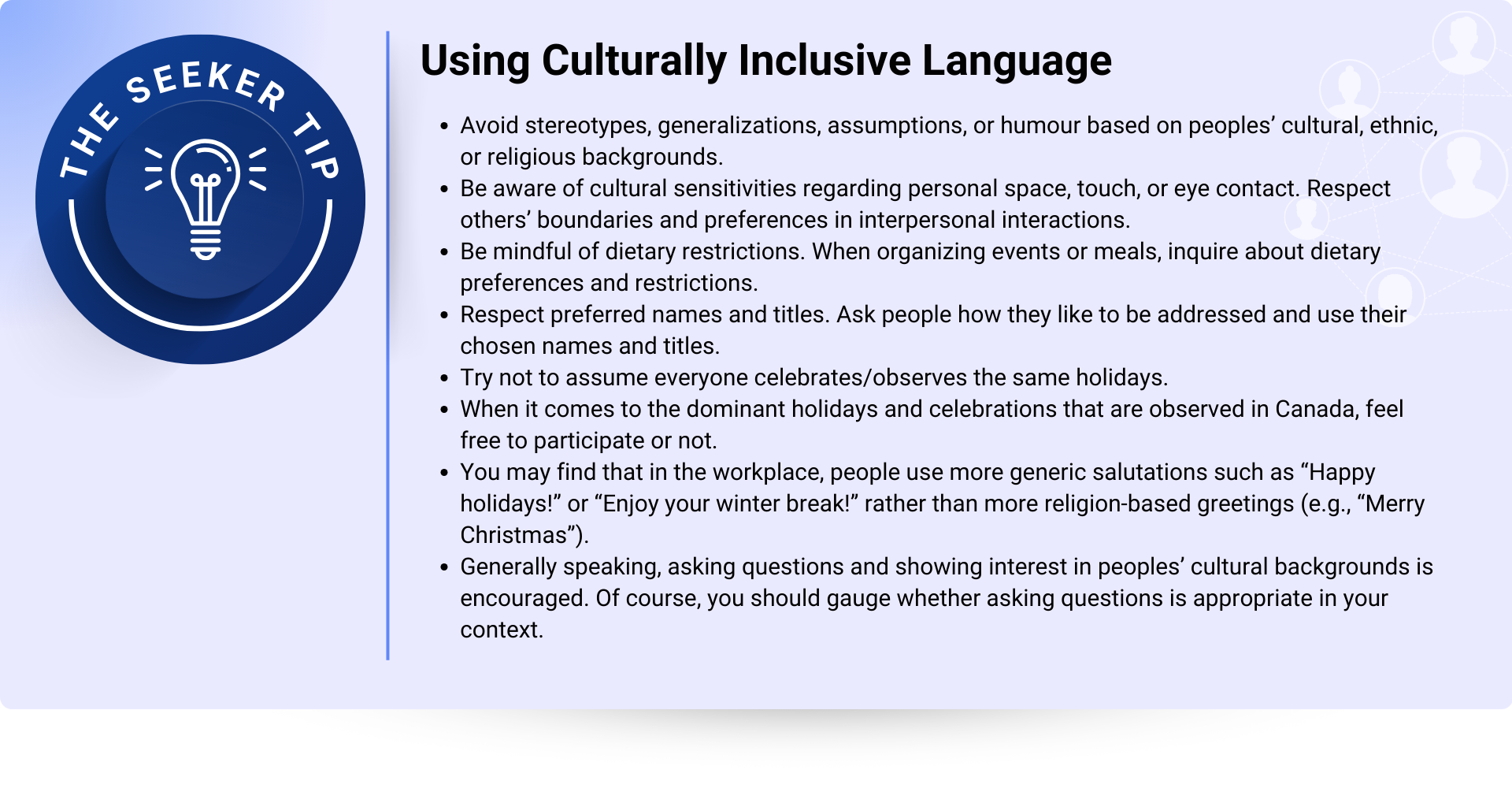
Canadian workplaces feature people from many diverse backgrounds. Try to use language that is respectful to those from diverse backgrounds.
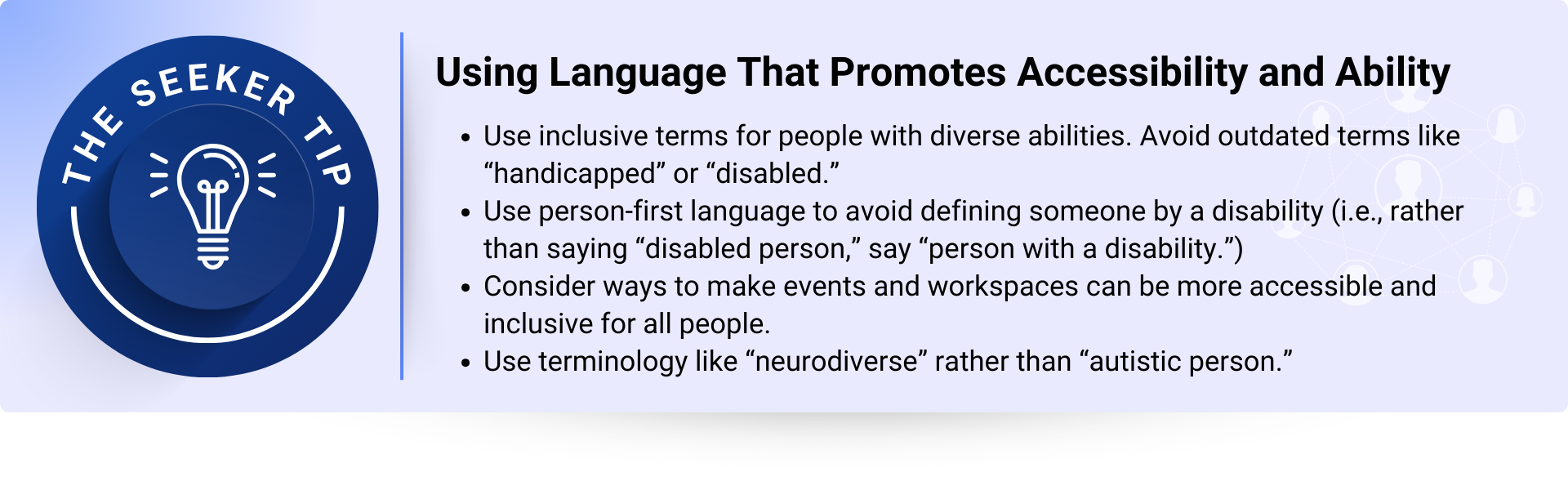
Language for Accessibility and Ability
Using respectful, accurate and up-to-date terminology related to accessibility and ability is a meaningful way of ensuring employees feel welcomed and safe in the workplace.
Language for Gender Inclusivity
Workplaces are shifting towards inclusive, gender-neutral terms instead of gender-specific ones. Gender-inclusive terms are language choices that aim to include and respect individuals of all gender identities by avoiding assumptions or exclusions related to gender. These terms promote a more inclusive and equitable communication environment, acknowledging and valuing diversity in gender expression and identity.